[sticky entry] Sticky: About this journal

Aug. 28th, 2026 04:53 pm
smmg: An illustration of a peacock from the Book of Kells (Default)

My main aim with this journal is to share my thoughts, experiences, and interesting things I've learned while I do my Celtic Studies degree. Celtic Studies is the study of Celtic languages, both modern and extinct, with focus on the six Celtic languages spoken today (Welsh, Irish, Scottish Gaelic, Breton, Manx, and Cornish) and their associated histories, literatures, cultures, folklores, politics, etc.
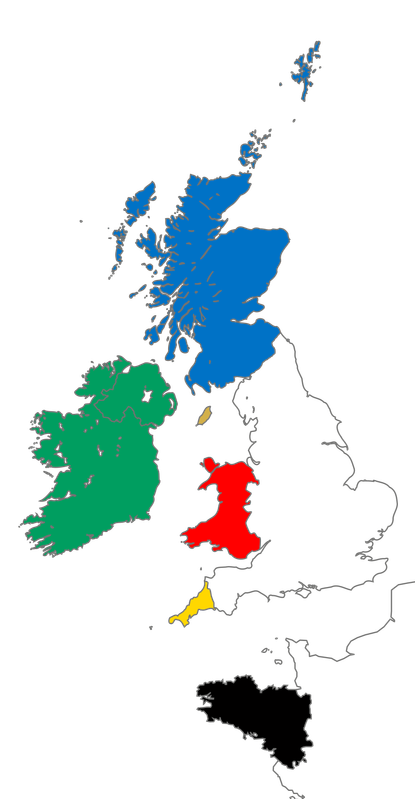
A map of the six Celtic nations: Ireland, Scotland, the Isle of Man, Wales, Cornwall, and BrittanyI've been interested in Celtic languages and Celtic nations my whole life, although I only started to seriously learn the languages/history/etc when I was a teenager. I'm from Wales, one side of my family is Cornish, and the other side is Scottish and Irish, so the Celtic nations and languages have always been very near and dear to my heart. I'm a second-language Welsh speaker, and I grew up with a little bit of Cornish, Irish, and Scots (the Germanic language) from my family.

As well as my Celtic Studies BA, I am also working on a Certificate of Higher Education in Modern Languages. I'm one of the Cornish Language Officers for the Association of Celtic Students. At the moment I'm planning on doing a postgrad in Celtic studies, archival studies, or linguistics, and I'd like to do a PhD in something eventually!

I would also like to try and aid in combatting the misinformation, ignorance, and bigotry against the Celtic nations, both online and in my daily life. I'd love to read comments and talk, as long as you're not looking for an argument or a "debate". I'm very aware that the Celtic Studies sphere can attract all sorts of alt-right/white supremacist types looking to distort and use our cultures and peoples to fuel their own bigoted agendas, and I will not tolerate that at all here. I love immigrants, Black people, Romani people, Travellers, Jewish people, and Muslims, and they are all a very welcome part of our Celtic nations and belong here.

I'm 23, and also transgender, multiply disabled, a multimedia artist, and a musician, so those are also likely to make themselves known in this journal from time to time.

Images are hosted on Postimages.

Languages I know/am learning:


First language: English

"Passive" focus
 - My grasp of these languages is fairly good so I'm mainly just polishing and maintaining my knowledge: Cymraeg

Main focus
- I'm actively working on my skills in these languages: Gaeilge, Kernewek

Dabbling - I study them a bit when I can find time: Scots, Deutsch

On pause - I have learned these languages a bit in the past and would love to come back to them in the future: Goídelc, Brezhoneg, Italiano, 汉语

Read more... )
smmg: An illustration of a peacock from the Book of Kells (Default)
NHS cancels all gender-affirming surgeries for adult patients of Welsh Gender Service with immediate effect

I don't even know what to say, I feel so defeated. What a horrible attack on trans rights, Welsh rights, and specifically trans Welsh rights.
smmg: An illustration of a peacock from the Book of Kells (Default)
One thing that really struck me and some other people in our Cornish decolonisation group was how confident the Native American authors in the book were in introducing themselves with their cultures. Many of them listed two or more Native cultures that they were part of, and some listed European ancestry too. I've never been very confident in stating my cultural background. I sometimes hesitate to call myself Welsh because my family don't come from Wales, even though I've lived my entire life here (except from the four months I just spent in Ireland on the exchange semester). I hesitate even more to call myself by the cultures that my family come from, even though they raised me. I wish I had the confidence to call myself "Welsh, Cornish, Scottish, and Irish". Maybe I'll start today. I think part of my hesitating is because there are a lot of people (mainly white Americans) who say some very strange and uncomfortable things about their Irish or Scottish ancestry, and understandably a lot of Scottish and Irish people in Scotland and Ireland don't like that, and I'm scared of receiving the same backlash, even though my Scottish and Irish family are still alive and raised me, unlike a lot of Americans who have Scottish/Irish heritage one or two hundred years ago, or more. Mostly Irish and Scottish people I've met in real life seem accepting of me though. I think the fact that my Cornish/Scottish/Irish family raised me to consider myself Cornish/Scottish/Irish is an invitation to do so, and to be part of those cultures. When people emigrate they don't do so with the goal of severing themselves and their children from their cultures.

But also I feel at odds with my ancestry in other ways. I have an English great-great-grandfather and an Ulster Scots great-great-great-grandfather, so I struggle with thinking about how my English/Ulster Scots/Lowland Scots ancestors and their nations were colonising and committing crimes against my Irish/Cornish/Scottish ancestors (yes Scotland ends up on both sides of this) (and my Welsh ancestors. Although they wouldn't have been my biological ancestors, I still view Welsh people in the past as like my cultural ancestors. They came before me in this land and culture and are still part of my history I think). I don't really know how to reconcile with this. I can accept that somewhere like Wales has a dual role as coloniser and colonised and I can accept our colonisation of Patagonia and role in the British Empire (although I don't condone it, but I can accept that it happened and empathise with those we colonised), but knowing that I had colonisers in my family history who were colonising my other ancestors' cultures feels harder to grapple with. I think in some way I am ashamed of my English and Ulster Scots ancestors, and I don't think I want to be. They're part of me too. I sort of have a belief that your ancestors are able to watch the living world and can see you, although I don't know where this belief came from, if it comes from any traditional belief passed down to me or if it's just my OCD. I hope that my Cornish/Irish/Scottish/Welsh ancestors would be proud that I want to be involved with language revitalisation, and that I'm studying Celtic Studies at university, and that I can even go to university. And maybe my colonising English and Ulster Scots ancestors would be pleased to see me, a Welsh/Scottish/Irish/Cornish person, so depressed and hopeless about my identity and my languages and cultures, speaking English as a first language. Can your ancestors love you? Can they hate you?

I like that in Indigenous spaces people introduce themselves with their cultures and the lands they're connected to. It's something I wish we did in Celtic Studies spaces. There are a lot of English people in Celtic Studies spaces, which isn't necessarily a bad thing (in fact, I think that if English people want to put in decolonisation work and be allies to Celtic peoples then there should be more of them getting involved in Celtic spaces), but I wish they would state "I'm English", otherwise we're going to end up with our colonisers leading our discussions and studies, which is something that has already happened in the Cornish language scene. I feel like that when I'm engaging in anti-racism things, I always state that I'm white, and that I know the discussion is not about me or for me, but that I want to learn. Why are so many of the most prominent voices in the Cornish language revival English ones? Why are we allowing the nation that took our language to lead it? Why are we letting our colonisers have the main say in our future? English people who consider themselves allies can and should be listening to Celtic peoples, but I do not think they should be the ones leading it (and I would say this applies to any oppressed group and their allies from their oppressing class). As the Sámi/Cornish person leading our decolonisation group said to me "One of the things that strikes me about Celtic studies is that it’s this primarily study of a group, and not study of the world by that group. In Sámi studies (and Indigenous studies generally), the primary focus is producing Sámi knowledge about the world, from a Sámi perspective." I think I like that idea better than what we have currently in Celtic Studies. I don't want to hear English, American, German, French, etc. academics spending years arguing about me and my nations and my ancestors. Why can Celtic Studies sometimes feel so Anglicised, and generally Westernised, to me. I mean, I'm pretty sure modern Celtic Studies academia came from German academics studying Celtic philology, and not from us producing our own knowledge, so perhaps that's why.

I've seen a number of English people online use Celtic names and avoid questions aimed at them about their cultural background, which seems sinister. I've seen Anglo-American academics complaining online about how hard it is in the Celtic Studies field when you don't have any Celtic ancestry. I've seen English academics getting stroppy online about how no one wants to listen to their opinion because they're an "outsider" and how actually outsiders have new perspectives to offer, which in my opinion is incredibly entitled to our endangered cultures and ignores the fact that we all know what your "outsider" opinions are already, as English worldviews have been shoved down the throats of 5 out of 6 Celtic nations for hundred of years. As a trans person, I don't care about cis academics' opinions on me, as a disabled person I don't care about abled academics' opinions on me, as a white academic I wouldn't expect non-white people to care about my opinions on them, and as a Celtic person I don't see why I should care about English academics' opinions on me.

My surname

Aug. 19th, 2026 11:55 pm
smmg: An illustration of a peacock from the Book of Kells (Default)
I have a double barrelled surname and the first element comes from my Scottish family, however I chose to de-Anglicise it to the Irish spelling as my grandpa's great-grandfather came from Ireland, but after talking to my granny I think it would make more sense for me to de-Anglicise it to the Scottish Gaelic spelling. I thought that the Lowland Scots branch of my family were descended from Ulster Scots and Irish Catholics (who converted to Protestantism), but it seems like they were just Scots Protestants with no Irish ancestry, and that the surname is indeed Scottish Gaelic in origin, and not Irish as I previously thought. But we don't have any recent Highlanders/Scottish Gaelic speakers on that side of the family at all, they're all Lowland and Ulster Scots, so I'm not sure if it would be weird for me to use a Scottish Gaelic surname? But also if the surname had survived being Anglicised then presumably it would have retained its Scottish Gaelic spelling today, so maybe it's fine to use it. Maybe I'd feel better about using a Scottish Gaelic surname once I start learning the language. I grew up listening to some Scottish Gaelic music at home but that's really my only exposure to it, and I never really considered it one of my heritage languages (or maybe not in the same way that I consider Cornish, Irish, and Scots my heritage languages, whereas with Scottish Gaelic it was more like an awareness that it was likely I had ancestors that spoke it, but longer ago).

Anyway, my family are going to buy me an Ancestry.com subscription for my birthday so I can look more into it, because our own family records only go back so far.
smmg: An illustration of a peacock from the Book of Kells (Default)


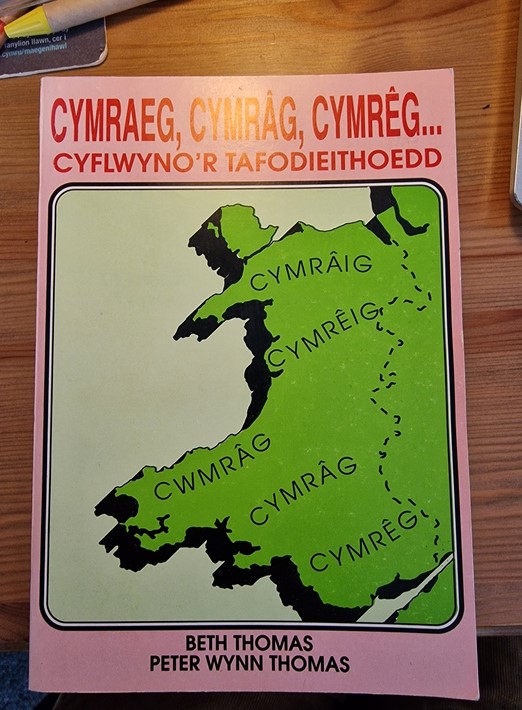
I've wanted this book for 3 years but I could only find it online for like £100 but I just found it in the charity shop I volunteer in for £7!! yippeeeeee

I feel like I've struck gold, found the holy grail, etc.

smmg: An illustration of a peacock from the Book of Kells (Default)
In the Cornish decolonisation circle I'm part of, we've been talking about Kernewekhe, or Cornicising. This came up when we were talking about terms to describe decolonisation, which is didrevesigeth or didrevesigans, but in the context of Cornwall we were specifically thinking that Kernewekhe is the word that makes most sense. We are not just decolonising and de-Anglicising ourselves, but specifically we are making things Cornish.

I've also been wondering about creating the terms om-Gernewekhe and/or das-Gernewekhe, that is, self-Cornicising and re-Cornicising. As in, we are not just Cornicising anything, but specifically ourselves and specifically things that used to be more Cornish in the past. We're reconnecting with our traditional identities, ideas, etc., and not just applying a Cornish coat of paint to concepts from the dominant English culture.
smmg: An illustration of a peacock from the Book of Kells (Default)
Ma'n deimlad chwerw ond melys, yn gwylio pawb arall yn graddio ac yn teimlo'n falch drostyn nhw, er mod i'n dal i orfod neud 2 flynedd cyn i fi allu graddio oherwydd fy iechyd :')
smmg: An illustration of a peacock from the Book of Kells (Default)
I know 'the Atlantic Archipelago' is the term we're moving towards using instead of 'the British Isles', and obviously anything is better than calling them 'the British Isles'. But like, as the term 'Atlantic Archipelago' is used currently, it's still the exact same thing? Just a different word.

I know 'Atlantic Archipelago' is supposed to be 'politically neutral' and 'purely geographic', but if it really was then shouldn't it include the Faroe Islands? Because they're really not that much further away from mainland Scotland than the Shetlands are. Are they not also part of this archipelago geographically?

I guess you could argue it's a cultural thing, and that the cultures of the Atlantic Archipelago have more in common with each other than we do with the Faroe Islands, but I feel like a lot of our similarities come from Anglicisation. Like, cultures in close proximity can obviously share things for reasons not due to colonialism, but considering the history of England oppressing the rest of the cultures in the islands, I feel like in this case it's not just due to proximity. And the Shetlands and Orkney also had a Scandinavian language until quite recently (and also I think identified more with being Norse than Scottish or British).

I think to me, it sometimes feels that we're just inventing a 'progressive' way to say 'British Isles' rather than questioning why our islands and cultures are grouped together under one term like that, or questioning who is included and excluded. More often than not, a lot of people just seem to mean England when they say 'Britain' or 'the British Isles'. So I think really we should be moving towards just referring to our cultures by their names, and if we're talking about our islands geographically, then I think we should consider that the Faroe Islands are also geographically part of the archipelago (and perhaps Iceland? Or is that too far away?)

I want to do more reading and research on the naming of these islands and on the cultural ties and shared identities between individual cultures here, but perhaps when my pain isn't flaring up so badly :')
smmg: An illustration of a peacock from the Book of Kells (Default)
I can invent new types of mutation that the world has never seen before.

/s/ -> /z/ would be kinda cool as a soft mutation, and /dʒ/ -> /nj/ as a nasal mutation. /s/ -> /z/ apparently happens in some dialect of Irish as an urú? I forgot where i read it. It's somewhere in Munster I think.

I might just have like an entirely new type of mutation too. The Brythonic languages all have soft, aspirate, and mixed (although Welsh grammar never really acknowledges the mixed one in the same way as Cornish or Breton do). Welsh additionally has the nasal mutation, and Cornish and Breton both have the hard mutation. But like what if there was another one.... what would it be...
smmg: An illustration of a peacock from the Book of Kells (Default)
Ok, so do I need to do sound changes for like:

Common Brythonic > old period of my conlang > middle period > modern period

And then I can start working on the vocabulary and grammar for the modern period. Or do I need to make the vocab/grammar for the old and middle periods too before I get to the modern period.

Am I over-doing it... probably
smmg: An illustration of a peacock from the Book of Kells (Default)
Starting on the Brythonic conlang today... I don't really know how to start with a conlang so I'm writing down all the phonemes and the letters that represent them in Welsh, Cornish, and Breton and then like... I'll somehow work out which ones to put in my language.

Bleh :/

Jul. 16th, 2026 06:02 pm
smmg: An illustration of a peacock from the Book of Kells (Default)
Need to find something interesting to do with Irish later, I have not felt like sitting down in front of a grammar workbook at all recently, which is usually my favourite thing. Maybe I should try and read something, or write something. I just need to do something fresh because I've been feeling a bit low since the TEG results and also just low in general in regards to language learning since like... October.
smmg: An illustration of a peacock from the Book of Kells (Default)
I failed the overall TEG exam but I passed the oral part so I think I can still get partial certification... I'm actually really upset :( It was a hard exam and very different to university exams but I honestly thought i did ok... I'm surprised I passed the oral but not the written one considering I hate oral exams so much.

It costs €150 to appeal the exam results LOL, I don't have the money. I will not be doing that. The course already cost me €100 and the exam cost €170 to take. I am not spending another €150 when they will probably still decide that it's a fail. I'm really upset with myself I thought I did enough to pass :(
smmg: An illustration of a peacock from the Book of Kells (Default)
I think I'm going to archive some old, non-Celtic studies posts from my site/old blog to here and tag them as "misc." or something. I was trying to code a blog on my site but I think it would just be easier to use this as my general blog, especially since I barely post anything that's not related to Celtic studies anyway.
smmg: An illustration of a peacock from the Book of Kells (Default)
The problem with lectures is that I get fatigued too easily and the problem with no lectures is that now I have no structure and routine so I get anxious. There's still like 3 months until I am in a lesson again :( I have somewhat of a routine over the summer with my music stuff and the charity shop and I'm trying to set specific days to study specific languages, so I'm trying to have a weekly schedule but I like to be given lessons and assignments and tasks :( But also those are so so hard because of my health. How do I win.
smmg: An illustration of a peacock from the Book of Kells (Default)
I got 71% for my medieval Irish archaeology module and 78% for Old Irish so I'm really happy :)
smmg: An illustration of a peacock from the Book of Kells (Default)
I want to read all my PDFs on indigenous language revitalisation and decolonisation and related topics before August because that's when I'm supposed to be re-doing the 2 essays I didn't manage to do in November/December, and I had been working on a question that was like "how can post-colonial perspectives enhance our understanding of history" or something like that, and the choice of questions they give me for the re-sit are going to be different but I'm really hoping there will be one related to decolonisation because that's what I'm really interested in writing about and learning more about.
smmg: An illustration of a peacock from the Book of Kells (Default)
I do completely understand where people are coming from when they say they wish Welsh had an equivalent of it/its pronouns, but also it/its pronouns are really an English concept. I think we need to decolonise our minds from English ways of thinking about gender, honestly. A lot of times I see English language around gender and sexuality translated or transcribed straight into Welsh, which isn't inherently bad I guess, but why do we have to borrow English words and concepts? Would it not be better to look at our own language and history for ways to talk about our identity and for ways to create new words that we as queer Welsh people might need that Welsh didn't have in the past? Welsh uses "hi" for she/it, and "e" and "o" for he/it, and "nhw" is becoming used as the gender neutral alternative (which I assume is an English influence from singular they/them). But also I have seen suggestions for "ŵ" to be used as a welsh language neo-pronoun, as well as "hw" which is based off of "hwy" which is the archaic/literary form of "nhw".
smmg: An illustration of a peacock from the Book of Kells (Default)
I do think Wales and the other Celtic nations could/should engage with Indigenous peoples around the world more. I've seen some people from Celtic nations describe themselves as Indigenous peoples (as well as other Indigenous peoples call us Indigenous too), and I think maybe we could call ourselves that?? (Especially I have been thinking about it in terms of Ireland and the Irish people in the north being described as Indigenous people in territory occupied by British settlers) But I also think that maybe we need to engage with the wider global Indigenous community more and acknowledge our own complicity in colonialism better before we can call ourselves that. I think some people can't grapple with our status as colonised and coloniser (e.g. Wales and y Wladfa, Scotland and Gaelic-speaking parts of Canada, etc). And it's not like there aren't other Indigenous peoples across the world who have been complicit in colonialism, genocide, etc. (e.g. the Māori and the Moriori genocide, Sámi being encouraged to settle North America, etc.) But I think they have a sense of being in a wider, global Indigenous community/sense of identity that we (Celtic peoples) don't. I don't think a lot of us were brought up to consider ourselves Indigenous/Native (I certainly wasn't).

Also it's not uncommon for white supremacists to be obsessed with our 'indigeneity' or whatever and to use the term to weaponise our marginalisation against immigrant/non-white members of our nations, so I think we definitely have to be careful with applying the term Indigenous with a capital I to ourselves. Of course 'indigenous' with a lower case i is frequently used to describe our languages and peoples and cultural practices from pre-Anglicisation/-Francisation.
smmg: An illustration of a peacock from the Book of Kells (Default)
Hmmm gramadach na Gaelainne nú tosú ag léamh leabhar inniu 🤔 Táim a d'iarraidh ''Basic Irish'' a chríochnú agus tá aonad amháin fós ann, ach táim a d'iarraidh leabhair a léamh as Gaelainn. Tá aistriúchán ''The War of the Worlds'' (''Cogadh na Reann'') agam agus ''Táin Bó Cuailnge'' sa Nua-Ghaelainn, agus dhá scéal gearr a fuaireas sa siopa carthanachta.

Profile

smmg: An illustration of a peacock from the Book of Kells (Default)
S.M. McLees-Gilbert

August 2026

S M T W T F S
      1
2345678
9101112131415
1617 18 19202122
2324252627 2829
3031     

Syndicate

RSS Atom

Tags

Style Credit

Expand Cut Tags

No cut tags
Page generated Sep. 9th, 2026 01:26 pm
Powered by Dreamwidth Studios