smmg: An illustration of a peacock from the Book of Kells (Default)
Whenever people from the north of England try to have some sort of solidarity with Celtic nations in the UK because "we all hate the south east, right" it's like... no you guys can still be really xenophobic towards us. The fact that you live in a poorer region of England doesn't exempt you from the fact that you still have xenophobia/Celtophobia to unlearn. If you want to show solidarity with us maybe unlearn some of your subconscious biases against minority cultures. Like... yes, sure, solidarity between working class people of England and Celtic nations, but please unlearn your subconscious xenophobia. We cannot have solidarity unless you unlearn your biases against us.
smmg: An illustration of a peacock from the Book of Kells (Default)
As I understand it, "British" in its original use simply referred to the peoples who spoke "British" and their language (British/Common Brittonic was the ancestor of Welsh, Breton, Cornish, and Cumbric). The largest island in this archipelago became known as Britain since it was the place where the Britons (British-speaking) peoples lived, and was called "Great Britain" in order to distinguish it from Brittany on the European continent, where Brittonic-speaking peoples migrated to and where their language evolved into Breton. Brittany is actually called "Little Britain" in Scottish Gaelic: A' Bhreatann Bheag. And Wales is also "Little Britain" in Irish: An Bhreatain Bheag.

When the Germanic dialects of the Angles, Saxons, and Jutes, and Old Irish came to Great Britain, "British" was still only used to refer to the Brittonic-speaking peoples. After the Acts of Union in the 1700s, the term "British" came to be used by all the inhabitants of the island of Great Britain to refer to themselves, and became a political identifier, rather than an ethnic/linguist one.

Because of the oppression and Anglicisation of the non-English nations of these islands at the hands of the English, I (and others) feel like "British" has basically become a synonym for "English", and the cultures/languages/histories of the non-English nations are erased by labelling them as "British" too. When people talk about "Britain" they are usually only talking about England, and rarely also about Ireland, Scotland, Wales, Cornwall, the Isle of Mann, and the Channel Islands (and when people online talk about "British accents" they are usually talking about one specific, upper-class English accent. But regional/class-based accents and classism are a topic for another day). Outside of these islands, Britain and England seem to be basically viewed as one and the same. Other people seem unaware of a number of the minoritised cultures here and our histories and struggles.

Because of this conflation of the terms "English" and "British", there has been more and more talk about renaming the "British Isles" to something with less political or colonial connotations. The "Atlantic Archipelago" is something I've seen a number of times in academia, although I've yet to see it be used outside of academic scenarios. The main issue I can think of is that there are other archipelagos in the Atlantic Ocean.

What are some other alternatives? The North Sea Archipelago? There are other archipelagos in the North Sea. The Celtic Archipelago? England is not a The Celtic nation, and Brittany (which is a Celtic nation) is not in the archipelago. The Irish Archipelago? After all, the islands do surround the Irish Sea. The Dogger Archipelago? I think that might be my favourite (but I think Doggerland is very cool and interesting so maybe I'm biased). But why do we need to rename the British Isles at all?

Why do we still all need to be grouped together in that way? As previously mentioned, when people talk about "Britain" they are, 9 times out of ten, actually talking just about England. If we were to rename our islands to "the Atlantic Archipelago" then I feel like this same issue would persist, just under a new name. Maybe instead we should just change the way we talk about ourselves. If you are just talking about England, then just say England. If you're not sure what you're saying applies to just England or elsewhere in the isles too (because we each have our own laws, cultures, history, etc.) then perhaps just do a bit of research to find out, rather than just assuming that because something happens in England then it must be uniform across the islands.

I think "British Isles" is a bad term that we need to retire, but I'm not entirely sure we need to replace it with anything or to continuously lump ourselves in with our oppressors in our day-to-day language.
smmg: An illustration of a peacock from the Book of Kells (Default)

I feel like it would be so much easier to talk about Celtic nations online if the general internet population understood that England ≠ Britain ≠ the UK ≠ the British Isles.

I remember someone I followed on Tumblr received an ask where the asker was going "I thought Welsh people were English because I thought England was the island, and Britain was the country with London etc".

I also feel like since there's been Welsh, Scottish, and Cornish people online recently saying "don't say Britain when you mean England", some people have taken that to mean "never say Britain and only say England", when we just mean "stop talking about Britain like it's one homogenised culture where everywhere is England".

smmg: An illustration of a peacock from the Book of Kells (Default)
I'm not really interested in engaging with anything where "British" is:
  1. Treated like one homogenised culture (that homogenised culture ALWAYS being English and ignoring the minority languages/cultures/nations here). And...
  2. It's completely ignored that the modern usage of "British" is very much a political term that begun existence with the Acts of Union. I.e., not the usage that just implies Britain as an island, or the "British Isles"1, or British being used to mean Common-Brythonic-speaking peoples and their language.


1: Although personally I think we should retire those geographical uses since they're just not politically neutral terms, and at worst have connotations of cultural genocide of the non-English nations of these isles at the hands of the English, and making us all "British". Think of that quote "Britishness is a political synonym for Englishness which extends English culture over the Scots, the Welsh, and the Irish". And I would add that the Cornish could very well do with being added to that quote.
smmg: An illustration of a peacock from the Book of Kells (Default)
I'm sure most Welsh people online have been plagued by images like these at some point:
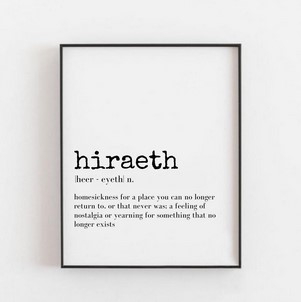

hiraeth
|heer-eyeth| n.
homesickness for a place you can no longer return to, or one that never was; a feeling of nostalgia or yearning for something that no longer exists.
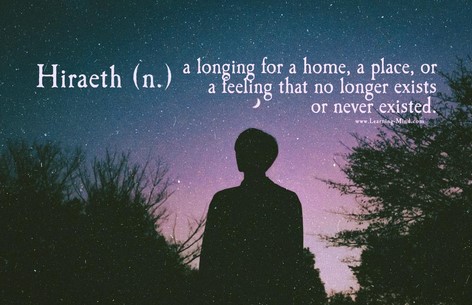
Hiraeth (n.)
a longing for a home, a place, or a feeling that no longer exists or never existed.
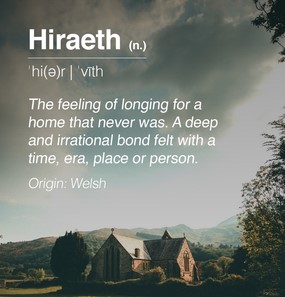
Hiraeth (n.)
'hi(ə)r | 'vīth
The feeling of longing for a home that never was. A deep and irrational bond felt with a time, era, place or person.
Origin: Welsh
Images that have some sort of aesthetic appeal, which sanitise and disconnect hiraeth from it's Welshness, and sometimes go as far as to claim it's an English word. And if they do acknowledge it's a Welsh word, it's always detached from the culture and history surrounding the word, and simply paint it as "longing" without any of its distinct Welshness. Often posted on some "cozy", "witchy", "cottagecore" blog with a distinct aesthetic centring around it being mystical and magical, at least in my experience. They always paint hiraeth as something poetic and vaguely mythical, that everyone who's not Welsh can also relate to. The (mis)use of the word on the internet is something that continues to bewilder and upset me every day.

Geiriadur Prifysgol Cymru (The University of Wales Dictionary) defines hiraeth as grief or sadness after the lost or departed, longing, yearning, nostalgia, wistfulness, homesickness, earnest desire. It's also cognate with the Cornish "hireth", the Breton "hiraezh", and the Irish "síreacht". Even Wikipedia recognises it as "a homesickness tinged with grief and sadness over the lost or departed, especially in the context of Wales and Welsh culture. It is a mixture of longing, yearning, nostalgia, wistfulness or an earnest desire for the Wales of the past", so why the hiraeth-bloggers don't seem to be able to do a quick bit of googling the word to find this, is beyond me. So yes, hiraeth does very much mean "yearning" and "longing" and similar things that these inspirational-quote-esque images will tell you. But I think for a lot of Welsh people, hiraeth very much carries a certain cultural and historical baggage that is always left out of what the "cozy cottagecore" bloggers will say about the word. That "yearning" is extremely related to the destruction of our culture and language at the hands of the English, and a longing to go back to how things were before - when our culture was less Anglicised, when we all were able to speak our own language, before our right to govern ourselves was taken from us, before England destroyed our communities and stole our resources....

Hiraeth is very much a Welsh word that can only be used in the context of Wales and our culture and history. If you are not Welsh, you cannot relate to it. How on earth can you relate to the loss of a culture that you are not a part of? You can't. Hiraeth is very exclusively only applicable to Wales and Welsh culture and history. I've often seen hiraeth compared to the Russian тоска and the Portugese saudade and various other words called "untranslatable" in a variety of languages, but I'd argue that as hiraeth is specific to Welsh culture, тоска is specific to Russian culture. Words in different languages can have similar meanings, but the cultural context that comes with them is going to obviously be different, as these different languages have different peoples, histories, and cultures attached to them. And even though hiraeth is cognate with the Cornish hireth and Breton hiraezh, I'd still argue that they're not direct, interchangeable translations, as hireth would very much carry Cornish cultural context with it, and hiraezh with Breton. This is why we often call hiraeth an untranslatable word - yes we can translate it as "yearning" and "longing" and such, but neither of those English words convey the same context that hiraeth does, and none of those other words in other languages carry the same cultural context either. The word can translate, but its cultural and historical context does not. It's lost all its distinct meaning and soul and Welshness now. The English word "yearning" does not carry that same baggage of culture loss.

It especially feels insulting when English people use the word hiraeth in the contexts of themselves, or when they act like it's an English word. This is very much our word that carries a heavy implication of the cultural and language destruction that you have committed (and continue to commit!) against us. Hiraeth never was, and never will be, applicable to anyone who is not Welsh and especially not to English people.

Perhaps the misuse and misinformation surrounding hiraeth online shouldn't upset me as much as it does. After all, it's continuing an established tradition of the misunderstanding, romanticisation, and othering of Welsh people and our language and culture, and also of the wider Celtic nations. I don't particularly think it's a coincidence that hiraeth has this sort of mystical aesthetic surrounding it online; people love to call the Celtic languages "magical" or "mythical", or think that they have some sort of inherent "otherworldly" or "elvish" quality to them (I don't think we can blame Tolkien solely for this, since this sort of attitude about Celtic languages and peoples has been on-going for hundreds, if not thousands, of years, but I do think he had a large part in adding to it in more recent times). I think there's something about this assumed, and often subconscious, romanticisation of Celtic languages that make hiraeth easy for certain people to latch on to, as they focus on the prettier, more poetic meaning of the word, and not the cultural erasure that comes with it. Our languages and cultures are marginalised, but that just makes our words more beautiful and exotic and interesting, apparently, and that's the sort of surface-level stuff that non-Celtic people seem to want to engage with, and not our heavy, difficult histories that have produced concepts such as hiraeth.

To be clear, I do think that hiraeth can certainly be a poetic and beautiful word. There are Welsh poets who have written and said wonderful things about it. But that's not the place of non-Welsh people to do that. And it's such a shame to see a word like this reduced to only widely being know by a sanitised, more easily palatable, Anglicised definition. Stripped of all the intricacies of what it actually is.

smmg: An illustration of a peacock from the Book of Kells (Default)
it does amaze me somewhat just how unfamiliar english people seem to be with the minority languages of britain and ireland. english people love to talk about how our languages looks unpronounceable and impenetrable or whatever, and in some cases aren't even aware of some minority languages' existence (usually seems to be the romance languags of the channel islands, angloromani, and scots they're the most unaware of. or at least scots is just assumed to be some sort of funny, uneducated dialect of english). which feels just bizarre and insulting, how are you so unaware of us and our languages and cultures, when we're your neighbours and when we even live amongst you in england? you've spent hundreds of years trying to eradicate us, and now you can't even acknowledge our existence, and make jokes about your ignorance, and don't even care to learn our languages when we all have to speak yours? when i meet people from outside these islands and i talk about celtic studies and the other non-celtic languages here, they always seem really interested and ask me questions and think it's so cool how english isn't the only language/culture around here, despite the fact that that's what they've assumed. but english people just do not seem to care as much, despite the fact that they've been our neighbours for hundreds of years. it's hard to feel a sense of comradery as a "united kingdom" or even as a wider "british isles" when english people behave like that about us.
smmg: An illustration of a peacock from the Book of Kells (Default)
there's been a number of articles on various news sites recently about cornish language revival and there's always comments like "i'm cornish and i don't care" "i live in cornwall and this isn't interesting to me" "i'm from cornwall and the cornish language is useless" etc etc. like christ it drives me insane. the absolute apathy. the disrespect/ignorance for your own language/culture/history. idk. i guess they just haven't decolonised their way of thinking but still. insanely frustrating.

i know there's a lot of english people living in cornwall who've displaced the actual cornish population (which has happened with my own cornish family members), so maybe that's a factor in it?? i.e. english people living in cornwall who just see it as a "beautiful sunny holiday retreat", or just another part of england and english culture, or whatever. but regardless, if you've moved somewhere with a minority culture i think you should also want to take interest in it at least a little bit?? especially like if you're from the place that has oppressed that minority culture for 100s of years, i think you should at least learn a bit about that culture's history and the damage that's been done to it etc.

idk. very frustrating.

smmg: An illustration of a peacock from the Book of Kells (Default)
leaving the uk is something i've considered for a couple of years now bc of transphobia but i just don't know where's better and i'm so scared. i'm eligible for irish citizenship but i didn't think ireland was much better than the uk. i doubt i'd have the money to leave anyway. and if i move outside of the uk and ireland (places where most of my family are) then i'll have to support myself on my own, which is impossible bc of my health. i mean i have some family in canada and the usa, but i know the usa's not great for trans rights, but i think canada might be better?? but it's just so far away and i've only met my family from there like twice.

i've never been outside of the uk and ireland. and what if the place i move to has an increase in transphobia after i move there. and i'd be leaving the celtic nations which feels wrong as a celtic studies student. like my my main special interest is centered around languages from here, and going further into continental europe, which i feel is a more likely destination than canada, would mean i wouldn't get to speak welsh or the other celtic languages and wouldn't be a part of celtic language communities irl anymore (i doubt i'd move to brittany, i have a feeling france isn't great for trans stuff??). and i get really awfully homesick anyway, especially as someone with a complicated relationship to the concepts of "home" and "belonging", and to wales and the 3 places my family are from (cornwall, scotland, and ireland). i don't know how i can just leave that all behind. i feel like i'd be giving up my identity as part of multiple minority cultures and as a speaker of minority languages. it's likely i'd still end up speaking english wherever i go bc it's fucking unavoidable, but i feel like i'd lose so much connection to wales and my family and cultures and heritage. i don't know. i've already grown up disconnected from the culture of where i'm from and the cultures of my family. i don't want to disconnect myself further.

not to mention the disability side of things, it's no good moving somewhere with trans rights if i can't get good help/treatment/benefits for my disabilities.

i was reading articles about english trans people moving abroad, and i don't think they realise how lucky they are in terms of the language side of things. they've obviously had to start learning new languages from the places they've moved to, but there are english speakers all over the world so they're never particularly isolated or disconnected from the english-speaking world.

and tbh you could probably say something similar for speakers of all non-minoritised languages. the issue with welsh is that obviously i would be in a minority speaking it abroad, but it's still very much a minoritised language in the country it's from. i'm not sure that english people realise that - while they still may have some issues with language barriers while living abroad - their language has such a global presence bc of colonialism, and it's not minoritised in the country it's from. obviously i'm not defending colonialism iam just saying that it has made it fairly easy for english-speakers to live pretty much wherever in the world they want without disconnecting and isolating themselves from english-speaking communities. i don't have that as a speaker of minority languages (i suppose there's y wladfa in argentina but i don't know what their trans/disability rights and stuff are like. or there's a gaeltacht in canada somewhere i believe?? but you know what i mean - there are those specific places, it's not like everywhere. and as for cornish and scots i have no idea. i highly doubt cornish has much of a presence at all outside of cornwall/the uk). and it's bc of that colonialism that my family languages are minoritised and that i grew up disconnected from my cultures. maybe i would have an easier time thinking about moving abroad if it wasn't for that. i want to be a part of the revitalisation and continued use of these languages, and i feel like i couldn't do it from so far away.

but then what should i prioritise?? my transness, my being a part of a minority culture(s), or my health as a disabled person?? it seems wherever i live that i can't have all 3. but i don't want to give up any of them. this is so naïve but i just wish the world was a fairer place.

smmg: An illustration of a peacock from the Book of Kells (Default)
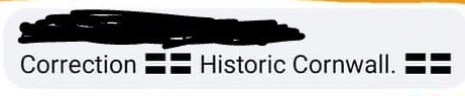
Correction 〓〓 Historic Cornwall. 〓〓
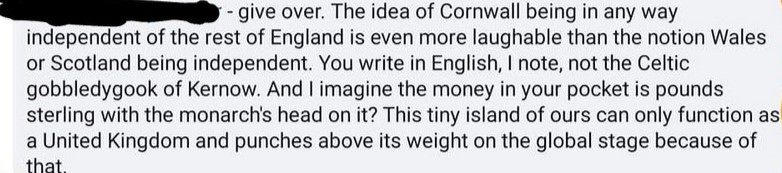
give over. The idea of Cornwall being in any way independent of the rest of England is even more laughable than the notion Wales or Scotland being independent. You write in English, I note, not the Celtic gobbledygook of Kernow. And I imagine the money in your pocket is pounds sterling with the monarch's head on it? This tiny island of ours can only function as a United Kingdom and punches above its weight on the global stage because of that.

my lord people like this drive me insane. whose fault's that that most cornish people can't speak cornish? which country and language has displaced and eradicated cornish?? you can't erase our languages and cultures and then turn around and tell us that our want for independence is invalid bc we don't have a distinct language or culture - we did, but you destroyed it, and now we have to rebuild it. and i suspect that if that person had commented in cornish, then there'd be people telling them to instead "speak the king's english" or whatever nonsense because the comment is on an english language post. and honestly it makes sense to reply in english considering the original post is in english. lots of us who can speak our celtic languages often don't use them on the internet bc a lot of the internet is in english, and if we want people to understand the corrections we make (like in the screenshot) then unfortunately we're only going to be understood and heard if we use english.

and the uk very much does not "function" if you actually open your eyes and pay attention to those of us outside of england. subjugating the non-english nations/peoples/languages does not make the uk "function". i hope the uk collapses within my lifetime, godbless. and i feel like the uk "punching above its weight on the global stage" is not great either and not something to be proud of or to want, when i feel like it "punching above its weight" definitely includes things like colonialism.

smmg: An illustration of a peacock from the Book of Kells (Default)
a strange trend i see is to call english a "non-native" or "non-indigenous" language to britain, which is bizarre as the english language very much is from britain. the english language as we know it evolved here as a distinct language from what was spoken by the anglo-saxons who settled here, so i would very much say that makes it an indigenous language. a language that is native/indigenous to britain just mean that the language originates from britain, it doesn't necessarily have to also mean that the language is marginalised. and how far back are you prepared to go before something is no longer considered native to the area? the ancestors of speakers of modern celtic languages were likely from the european continent, and even further back both english and the celtic languages come from proto-indo-european, so are none of them "really" native to britain in that case, if they have a traceable root from somewhere else?

and it's strange bc english and scots both come from the same germanic roots, but i never see anyone claiming that scots isn't actually native to britain/scotland bc of those roots. whereas some people (online and those i've talked to irl) are happy to claim that english isn't actually native to england bc it evolved from old english which ultimately evolved from the germanic languages brought over by anglo-saxons. and old english is also what scots evolved from, so scots shares those same roots.

i suppose maybe it's not that strange, bc the internet is very american, so i suppose people are taking the model of america and it's indigenous languages and applying it to britain, when it isn't exactly the same situation.

[edit: i should have clarified with that last point - in the case of somewhere like america or new zealand, their indigenous languages are all minoritised, but in somewhere like britain that is not the case.]

smmg: An illustration of a peacock from the Book of Kells (Default)
i've probably said this before but it's so absolutely crushing when i talk to english people and they have no idea that cornwall has a separate culture and language. like they don't even know we exist. and sometimes they laugh about their ignorance like "haha i didn't even know cornwall has it's own language, let alone that it's a celtic nation". sorry but it makes me a little insane. like as someone who is cornish diaspora who lives in wales bc my cornish family have largely been displaced from their homes by english tourists/second home owners, and moving for better job/education opportunities. it's so insulting and depressing. every time i meet an english person at university and we talk about our degrees i'm always mentally preparing myself for this conversation. it's so exhausting. can't necessarily blame them either bc i know their country does not teach about what they've done to cornwall, wales, etc. but why joke about your ignorance. ''i'm from england and i didn't even know about cornwall having a distinct culture hehe'' ok but why. do you never bother to learn things about the world on your own. do you ever wonder why cornwall has one of the highest poverty rates in the uk and why people are so angry about tourism and second homes there? i'm sorry but like. do you never listen to/read/watch the news. sorry it's just absolutely infuriating.

Profile

smmg: An illustration of a peacock from the Book of Kells (Default)
S.M. Mac Giolla Íosa Gilbert

July 2026

S M T W T F S
    1234
5 67891011
12131415 161718
19 2021 222324 25
2627 28 293031 

Syndicate

RSS Atom

Tags

Style Credit

Expand Cut Tags

No cut tags
Page generated Aug. 8th, 2026 04:29 pm
Powered by Dreamwidth Studios