"Celtic"

Jan. 16th, 2026 06:19 pm
smmg: An illustration of a peacock from the Book of Kells (Default)
I think sometimes the use of the word "Celtic" makes people try to find connections where there aren't really any, or I guess it's more like they only focus on the connections between "Celtic" cultures and ignore how those things actually link in with other European cultures, and also cultures in Asia and Africa. Because people hear the word "Celtic" in "Celtic studies" or "Celtic nations" and I think it can sort of subconsciously force people to think of some things as being uniquely Celtic, when there isn't really anything unique to Celtic nations except a Celtic language. but the fact that we call our nations "Celtic nations" and our field "Celtic studies" makes people assume certain things and only focus on how we're linked to each other, instead of to other cultures around us.

Maybe the word "Celtic" just has connotations that annoy me, especially when it's used by people outside of Celtic studies academia, but what else are we supposed to call our languages/ourselves.
smmg: An illustration of a peacock from the Book of Kells (Default)
I find it hard to engage with fantasy as a genre sometimes because of a large number of authors' treatment of Celtic cultures in their works. I think the inherent connection of our cultures with fantasy and magic is a problem, and a continuation of the Victorian-era romanticisation and othering of Celtic peoples. I do think it's a problem when aspects of Celtic cultures get inherently linked with magic and non-humans, like how dwarves in a lot of fantasy seem to get Scottish accents and often seem to be the only characters coded as Scottish within a work (The Lord of the Rings/Hobbit films spring immediately to mind). Because dwarves are often portrayed as tough, rugged warriors? A tired stereotype of Scottish people (particularly Highlanders), I feel.

But even when there is no direct connection within a text that "Celtic = magic/non-human", I still feel that the mere presence of Celtic aspects in fantasy is an inherent issue. Why is it that writers seem to subconsciously associate our cultures with fantasy? Why do our languages (or bastardised versions of them) make an appearance in fantasy, when they often do not within other genres? Why do so few authors want to use German/French/Italian/etc in their fantasy works? Why are languages like Welsh and Irish more of an "obvious" choice for them?

Why are our languages and cultures seen as inherently more easy to associate with fantasy? There is this assumption held by the general public who are not into Celtic Studies that Celtic cultures are much more "ancient" in some way than other European cultures. People assume that the ancient Celts and the modern day Celtic nations form some sort of unbroken, inherited sense of uniform Celticness, and that that gives us our cultures some sort of mythical properties because of our "unbroken link to the past" or whatever. This manifests in people assuming that we are more "primitive", and that makes us easier to fit into a medieval-style high fantasy setting. The "noble savage" stereotype of Celtic peoples. The sort of subconscious idea that we have "ancient druidic power" that makes us more "fantastical".

It's easy to poach from minoritised cultures. Few people will notice you've done it, and the few that do notice will have such a small voice compared to the majority that are indifferent. And people will defend authors' decisions to other us and even deny that Celtic languages have been used in a certain work (I'm especially thinking of fans of The Witcher... I'll likely never get into those books/games/show). It's funny to me when I see that there's a wolf/man character in Elden Ring called "Blaidd", because that just means "wolf" in Welsh. I'm sure it sounded "cool" and "fantasy" to whoever named him that, but it's just blatantly taking a very common/obvious word from a minority language because you think that no-one who plays your game will know what it means and just think it's a fantastical word. Or "Blaidd means wolf" will just be a cool bit of trivia.

Do authors who include our languages even know how to pronounce them? And if they do, does it make it better? Personally I'd still be upset if an author who spoke a Celtic language included that language in fantasy, if they were including it without thinking about how they are portraying it, or why they included a Celtic language and not, for example, a Romance language. If they included a Celtic language or culture in their work, and still fell into all the same old stereotypes of Celtic peoples, it would still be bad. To be honest, the inherent inclusion of a Celtic language in fantasy is enough to put me on edge, even if the author isn't saying that "Celtic = magic" or whatever.

I do like fantasy as a genre. I just find it hard to engage with. There are fantasy books, films, and games that I love, despite any Celtic-related flaws they may have. Their inclusion of Celtic aspects may still make me uncomfortable though, or snap me out of my experience of enjoying the work. When I was playing Arcanum: Of Steamworks and Magick Obscura in 2023, I initially found it funny that there was a kingdom called Cumbria, since that is the name of an English county that used to be Brythonic-speaking until the middle ages, and the name is related to the modern Welsh word for Wales, "Cymru". And the kingdom also had Dragon Knights, which obviously felt very Welsh. But in retrospect, I think that perhaps a political point was trying to be conveyed there, considering the fictional Cumbria's relationship to the Unified Kingdom (clearly based off the real world United Kingdom). Cumbria had been subdued by the Unified Kingdom and had parts of its territories annexed. I think maybe I'd be interested to go back at some point and examine that part in the game more closely, as an analogy for Wales and its place in the UK. So I do think Celtic peoples can be put into fantasy. I just also wonder why authors seem to have a more difficult time putting us into sci-fi, action, thriller, horror, slice-of-life, etc.

I myself have a fantasy story that I've been working on ("writing" would be an incorrect term since it's mostly note-making, and I rarely get around to actually writing anything fiction these days. A shame. I should try and get back into it...) So far I've purposefully avoided putting any characters with any Celtic names or any other Celtic-coding into my story. I would like to, but I'm not sure on the best way to go about it. I think I would be interested in writing a fantasy story that subverts all of the usual conventions of including Celtic-coded characters in fantasy. Again, I'm not sure how to do that. And I would be interested in reading fantasy by other authors from Celtic nations who want to challenge all the usual Celtic-based tropes of fantasy.
smmg: An illustration of a peacock from the Book of Kells (Default)
I think it's weird how people seem to assume that the Celtic nations have always had some sort of ancient, unbroken "Celtic identity" that stretches back thousands of years, and that we've always had some sort of sense of "Celtic connection" between us that is similarly ancient and unbroken. When, to our best knowledge, no one from the modern Celtic nations was describing themselves or their languages as "Celtic" until George Buchanan in the 1500s and Edward Lhuyd in the 1700s, and that the relationship between the Brythonic languages, Gaelic languages, and older continental Celtic languages wasn't recognised or labelled as "Celtic" until then either. It is, at best, strange and historically inaccurate when people act like our cultures have always had some sort of strong, unbroken, ancient Celtic identity, and at worst it romanticises our cultures by painting them as ultra conservative, traditional, ancient, and somehow more inherently in-touch with our past. And potentially has weird white supremacist connotations with the fixation on the "ancient"/"traditional" aspects of it all and the emphasis on our "ancient heritage"/"ancient identity".
smmg: An illustration of a peacock from the Book of Kells (Default)
I'm sure most Welsh people online have been plagued by images like these at some point:
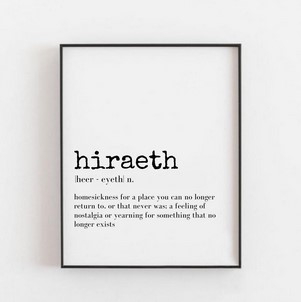

hiraeth
|heer-eyeth| n.
homesickness for a place you can no longer return to, or one that never was; a feeling of nostalgia or yearning for something that no longer exists.
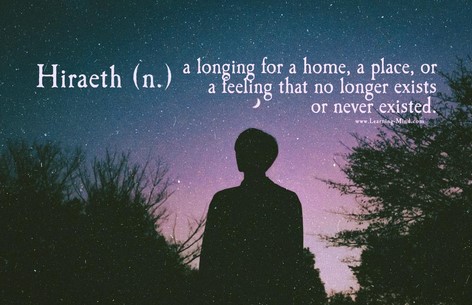
Hiraeth (n.)
a longing for a home, a place, or a feeling that no longer exists or never existed.
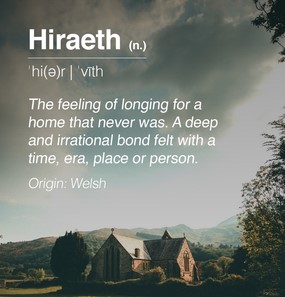
Hiraeth (n.)
'hi(ə)r | 'vīth
The feeling of longing for a home that never was. A deep and irrational bond felt with a time, era, place or person.
Origin: Welsh
Images that have some sort of aesthetic appeal, which sanitise and disconnect hiraeth from it's Welshness, and sometimes go as far as to claim it's an English word. And if they do acknowledge it's a Welsh word, it's always detached from the culture and history surrounding the word, and simply paint it as "longing" without any of its distinct Welshness. Often posted on some "cozy", "witchy", "cottagecore" blog with a distinct aesthetic centring around it being mystical and magical, at least in my experience. They always paint hiraeth as something poetic and vaguely mythical, that everyone who's not Welsh can also relate to. The (mis)use of the word on the internet is something that continues to bewilder and upset me every day.

Geiriadur Prifysgol Cymru (The University of Wales Dictionary) defines hiraeth as grief or sadness after the lost or departed, longing, yearning, nostalgia, wistfulness, homesickness, earnest desire. It's also cognate with the Cornish "hireth", the Breton "hiraezh", and the Irish "síreacht". Even Wikipedia recognises it as "a homesickness tinged with grief and sadness over the lost or departed, especially in the context of Wales and Welsh culture. It is a mixture of longing, yearning, nostalgia, wistfulness or an earnest desire for the Wales of the past", so why the hiraeth-bloggers don't seem to be able to do a quick bit of googling the word to find this, is beyond me. So yes, hiraeth does very much mean "yearning" and "longing" and similar things that these inspirational-quote-esque images will tell you. But I think for a lot of Welsh people, hiraeth very much carries a certain cultural and historical baggage that is always left out of what the "cozy cottagecore" bloggers will say about the word. That "yearning" is extremely related to the destruction of our culture and language at the hands of the English, and a longing to go back to how things were before - when our culture was less Anglicised, when we all were able to speak our own language, before our right to govern ourselves was taken from us, before England destroyed our communities and stole our resources....

Hiraeth is very much a Welsh word that can only be used in the context of Wales and our culture and history. If you are not Welsh, you cannot relate to it. How on earth can you relate to the loss of a culture that you are not a part of? You can't. Hiraeth is very exclusively only applicable to Wales and Welsh culture and history. I've often seen hiraeth compared to the Russian тоска and the Portugese saudade and various other words called "untranslatable" in a variety of languages, but I'd argue that as hiraeth is specific to Welsh culture, тоска is specific to Russian culture. Words in different languages can have similar meanings, but the cultural context that comes with them is going to obviously be different, as these different languages have different peoples, histories, and cultures attached to them. And even though hiraeth is cognate with the Cornish hireth and Breton hiraezh, I'd still argue that they're not direct, interchangeable translations, as hireth would very much carry Cornish cultural context with it, and hiraezh with Breton. This is why we often call hiraeth an untranslatable word - yes we can translate it as "yearning" and "longing" and such, but neither of those English words convey the same context that hiraeth does, and none of those other words in other languages carry the same cultural context either. The word can translate, but its cultural and historical context does not. It's lost all its distinct meaning and soul and Welshness now. The English word "yearning" does not carry that same baggage of culture loss.

It especially feels insulting when English people use the word hiraeth in the contexts of themselves, or when they act like it's an English word. This is very much our word that carries a heavy implication of the cultural and language destruction that you have committed (and continue to commit!) against us. Hiraeth never was, and never will be, applicable to anyone who is not Welsh and especially not to English people.

Perhaps the misuse and misinformation surrounding hiraeth online shouldn't upset me as much as it does. After all, it's continuing an established tradition of the misunderstanding, romanticisation, and othering of Welsh people and our language and culture, and also of the wider Celtic nations. I don't particularly think it's a coincidence that hiraeth has this sort of mystical aesthetic surrounding it online; people love to call the Celtic languages "magical" or "mythical", or think that they have some sort of inherent "otherworldly" or "elvish" quality to them (I don't think we can blame Tolkien solely for this, since this sort of attitude about Celtic languages and peoples has been on-going for hundreds, if not thousands, of years, but I do think he had a large part in adding to it in more recent times). I think there's something about this assumed, and often subconscious, romanticisation of Celtic languages that make hiraeth easy for certain people to latch on to, as they focus on the prettier, more poetic meaning of the word, and not the cultural erasure that comes with it. Our languages and cultures are marginalised, but that just makes our words more beautiful and exotic and interesting, apparently, and that's the sort of surface-level stuff that non-Celtic people seem to want to engage with, and not our heavy, difficult histories that have produced concepts such as hiraeth.

To be clear, I do think that hiraeth can certainly be a poetic and beautiful word. There are Welsh poets who have written and said wonderful things about it. But that's not the place of non-Welsh people to do that. And it's such a shame to see a word like this reduced to only widely being know by a sanitised, more easily palatable, Anglicised definition. Stripped of all the intricacies of what it actually is.

smmg: An illustration of a peacock from the Book of Kells (Default)
does anyone else remember the weird discourse over whether fae/faer pronouns are "appropriating celtic culture" ?? that was strange.

genuinely at a loss as to what those people thought was being appropriated. the word "fae" does not come from a celtic language, and fae/fairies are not unique to celtic nations. so if neither the word or the concept come from the celtic nations, then what exactly is being appropriated here?? tumblr is so fascinating.

i vaguely remember someone did a survey on if it was appropriation or not, and posted the results which had things like "i know many celts who have told me it's appropriation". the use of the word "celt" here just feels so weird, it gives me such bad vibes when like modern people today describe themselves/others as celts.

smmg: An illustration of a peacock from the Book of Kells (Default)
leaving the uk is something i've considered for a couple of years now bc of transphobia but i just don't know where's better and i'm so scared. i'm eligible for irish citizenship but i didn't think ireland was much better than the uk. i doubt i'd have the money to leave anyway. and if i move outside of the uk and ireland (places where most of my family are) then i'll have to support myself on my own, which is impossible bc of my health. i mean i have some family in canada and the usa, but i know the usa's not great for trans rights, but i think canada might be better?? but it's just so far away and i've only met my family from there like twice.

i've never been outside of the uk and ireland. and what if the place i move to has an increase in transphobia after i move there. and i'd be leaving the celtic nations which feels wrong as a celtic studies student. like my my main special interest is centered around languages from here, and going further into continental europe, which i feel is a more likely destination than canada, would mean i wouldn't get to speak welsh or the other celtic languages and wouldn't be a part of celtic language communities irl anymore (i doubt i'd move to brittany, i have a feeling france isn't great for trans stuff??). and i get really awfully homesick anyway, especially as someone with a complicated relationship to the concepts of "home" and "belonging", and to wales and the 3 places my family are from (cornwall, scotland, and ireland). i don't know how i can just leave that all behind. i feel like i'd be giving up my identity as part of multiple minority cultures and as a speaker of minority languages. it's likely i'd still end up speaking english wherever i go bc it's fucking unavoidable, but i feel like i'd lose so much connection to wales and my family and cultures and heritage. i don't know. i've already grown up disconnected from the culture of where i'm from and the cultures of my family. i don't want to disconnect myself further.

not to mention the disability side of things, it's no good moving somewhere with trans rights if i can't get good help/treatment/benefits for my disabilities.

i was reading articles about english trans people moving abroad, and i don't think they realise how lucky they are in terms of the language side of things. they've obviously had to start learning new languages from the places they've moved to, but there are english speakers all over the world so they're never particularly isolated or disconnected from the english-speaking world.

and tbh you could probably say something similar for speakers of all non-minoritised languages. the issue with welsh is that obviously i would be in a minority speaking it abroad, but it's still very much a minoritised language in the country it's from. i'm not sure that english people realise that - while they still may have some issues with language barriers while living abroad - their language has such a global presence bc of colonialism, and it's not minoritised in the country it's from. obviously i'm not defending colonialism iam just saying that it has made it fairly easy for english-speakers to live pretty much wherever in the world they want without disconnecting and isolating themselves from english-speaking communities. i don't have that as a speaker of minority languages (i suppose there's y wladfa in argentina but i don't know what their trans/disability rights and stuff are like. or there's a gaeltacht in canada somewhere i believe?? but you know what i mean - there are those specific places, it's not like everywhere. and as for cornish and scots i have no idea. i highly doubt cornish has much of a presence at all outside of cornwall/the uk). and it's bc of that colonialism that my family languages are minoritised and that i grew up disconnected from my cultures. maybe i would have an easier time thinking about moving abroad if it wasn't for that. i want to be a part of the revitalisation and continued use of these languages, and i feel like i couldn't do it from so far away.

but then what should i prioritise?? my transness, my being a part of a minority culture(s), or my health as a disabled person?? it seems wherever i live that i can't have all 3. but i don't want to give up any of them. this is so naïve but i just wish the world was a fairer place.

smmg: An illustration of a peacock from the Book of Kells (Default)
First of all, "Celtic blood" and "Celtic DNA" are not something that exist. Quite frankly, that is a white supremacist idea (unfortunately a lot of those seem to get into Celtic-related spaces...)

At it's most sinister, blood percentage is used in places like America to rob Native peoples of their Native identifies if they have below a certain percentage of Native ancestry. Regardless of if they've lived their entire lives brought up by other Native Americans and are very much a part of their culture. The ultimate aim of this is to completely erase Native American cultures, languages, histories, and anyone who identifies with them. Which is genocide.

I won't tolerate those kinds of people who love to talk about their "Celtic warrior blood" or whatever when that ideology lines up with fascism and eugenics.

Your lived experiences with a culture are what make you a part of said culture, not what's in your DNA. Modern Celtic identity is based on the presence of a modern Celtic language, not on DNA.

It is very frustrating when I see Celtic diasporas (mostly Irish/Scottish diasporas in America) claim they're allowed to call themselves Irish because they have "10.5% Irish blood" or whatever, but then turn around and say that immigrants who actually live in Ireland are not really Irish, or that the children of immigrants who have lived in Ireland their whole lives aren't really Irish either.

I identify as Welsh because I was born and raised in Wales. Quite frankly, it would be weird if I didn't identify with the country I've lived in my whole life. But that doesn't mean I can't also identify with my family's cultures. My family are Cornish, Scottish, and Irish, and I identify as Cornish/Scottish/Irish diaspora because I was raised by my family from those places. I do not identify with those places because of my "blood percentage".

My mam is from Scotland and has an Irish mother and a Scottish father. She also identifies as Welsh because she lives in Wales and it's her home. She has a right to learn Welsh and to call herself Welsh. I also have family in Wales who weren't from Wales originally, and who still don't identify as Welsh. And that is entirely their own choice.

I also have an English great-great-grandfather and an Ulster Scots great-great-grandfather. Whatever "percentage English" or "percentage Ulster Scots" that makes me, I don't care. My English and Ulster Scots ancestors passed away long before I was born. I wasn't raised by them and I don't identify with those cultures. I identify as having English and Ulster Scots heritage, because they are undeniably part of my family history, although they are not really that relevant to me. My English great-great-grandfather moved to Ireland after the famine, and my Ulster Scots great-great-grandfather moved to Scotland around a similar time. Obviously this was long before I was born, and I didn't know them at all. I haven't had any relatives in Northern Ireland since pre-partition, and the culture of the north has changed a lot since then, and I'm not going to claim I somehow have innate knowledge or am some sort of authority on modern things like the Troubles.

The Celtic Nations and languages are for everyone, whether they were born here or if they chose to make a Celtic Nation their home later in life.

We can't cry about how we are oppressed, and then turn around and act absolutely vile towards other minorities.

We can't cry about how hardships in our Celtic Nations forced people to emigrate to other countries, and then turn around and get angry at immigrants coming to the Celtic Nations who are also looking to escape hardships in their home countries.

How hypocritical is that?

My mam's side of the family have only been in Wales since the mid-1980's, and my dad moved later, but because I am white I am seen to "belong" to Wales more than non-white people. I know non-white people who are first language Welsh speakers and whose families have been in Wales for much longer than mine. But their Welshness is brought into question a lot more than mine is. Both them and me are Welsh. Someone who moves to Wales tomorrow and makes this country their home is also Welsh and belongs here just as much as the rest of us.

Although I have had the odd person be weird to me about my cultural background, it's not anything like what I've seen non-white Welsh people receive. It puzzles me how other white people in Celtic Nations can claim they experience racism, when surely they can clearly see how much worse non-white people in Celtic Nations get treated. Do they forget the word xenophobia exists? Or even anti-Irish sentiment or Celtophobia? At worse, white Celtic people claiming they experience racism are actively making it harder for non-white Celtic people to talk about their experiences of racism within the Celtic Nations (that they receive from white Celtic people).

How are you not aware of what other people in your own country are experiencing? Are you really such a self-centred hypocrite that you'll (rightfully) complain about how people ignore the oppression that Celtic Nations and Celtic languages have faced, but then ignore minorities within our nations who are also suffering?

And what does "(whatever)% blood" actually mean practically for you? Culture isn't passed down through DNA, it's something you usually learn from the people raising you (and the country you live in, if the county's culture is different to your family's). A couple of times I've had people tell me I'm not really Welsh even though I've lived my entire life here, just because I was the first person in the family born in Wales. The blood percentage model leaves no room for my Welshness and my lived experience being raised in Wales, just because I'm not "ethnically Welsh".

When I get called "half-Cornish" because my dad is from Cornwall, what does that even mean? Which half of me? People with multiple cultural identities like me should be celebrating them all, not splitting ourselves in to fractions and percentages. We should be celebrating our abundance of cultural experiences and connections, both to the place we're from and the places our families are from.

If you are a member of any Celtic diaspora and want to identify with that place, then go ahead, but you need to actually put in the work to be part of that culture. Learn the history and the language, read the literature, and very importantly learn about the modern culture of that place especially if you have no living relatives from there. The culture will have changed a lot if your ancestors emigrated 100 years or 200 years or however long ago.

Don't just say you're Irish-American/Scottish-American/etc as some sort of claim of being a minority, while putting in absolutely no effort to be a part of or to help save that oppressed culture that you claim to care about. Being a part of a culture means that you have to do the difficult things that are also part of it, not just the easy things that benefit you or that you can use to seem more "interesting" or "exotic" or "minoritised" or whatever.

smmg: An illustration of a peacock from the Book of Kells (Default)
claiming that christianity isn't a "real and true" part of irish culture or whatever feels.... wrong. ireland has been largely christian since the 5th century, and so christianity has been a part of the culture for well over a thousand years. i'm not sure how to word it but to me that feels like if something has been part of a culture for that long then it definitely is woven into it and a "proper and real" part of it by this point..?? the idea that pagan beliefs are more "valid" or are like the "more authentic religious beliefs" for irish people (and tbh other celtic peoples) is.. annoying to say the least, since christianity has been a part of every celtic nation for hundreds of years. if i recall correctly, the early irish took so well to christianity that they didn't even have any martyrs??

it's been a while since i did my class on christianity in early irish literature. but the things i've seen some people say today (st patrick's day) about christianity in ireland are annoying to me. i don't think the introduction of christianity was a tool of colonisation in ireland in the same way it was in the americas [edit: ireland had already been christian for a few hundred years when britain began to invade/colonise it], which seems to be a comparison that some people have made - either consciously or subconsciously. and even elements of a culture that have arisen due to its colonisation are still real and valid parts of it anyway, i would argue. and that taking away such elements would only do even more damage. and tbh a lot of people trying to "connect with their true and real cultures from 1000 years ago" can very easily veer into fascist territory. not always, but it is easy for them to get into white supremacist ideas, which are a plague upon this field.

not sure if there are many other celticists on here, or any medieval academics, but feel free to correct my vaguely-remembered information. but as a celtic studies student from wales with family connections to 3 other different celtic nations, a lot of things i see online about christianity and paganism in regards to the celtic nations do irk me somewhat.

smmg: An illustration of a peacock from the Book of Kells (Default)
there are 6 modern celtic languages spoken today, which can be divided into 2 branches: goidelic/gaelic and brittonic/brythonic.

the goidelic/gaelic languages:
  • gaeilge / gaeilg / gaeilic / gaelainn / irish / irish gaelic / gaelic*
  • gàidhlig / scottish gaelic / scots gaelic / gaelic**
  • gaelg / manx
*irish has a number of different regional names for it in irish

**scottish gaelic can just be called gaelic, which helps distinguish it from scots (a germanic language related to english with different varieties spoken in scotland and ulster). scots is not a celtic language so it isn't related to scottish gaelic, but nevertheless people still get them confused with each other.

the brittonic/brythonic languages:
  • cymraeg / welsh
  • brezhoneg / breton
  • kernewek / kernowek / kernûak / cornish***
*** modern revived cornish has a number of different orthographies

other points:
  • the celtic nations refers to the places where these 6 modern celtic languages are spoken: ireland, scotland, the isle of man, wales, brittany, and cornwall.
  • celtic identity is very tied to the presence of a modern celtic language. there is nothing that all of the celtic nations have in common that isn't also shared by some other cultures, except for a celtic language. places without a modern celtic language are not celtic. a large part of europe and parts of west asia were celtic-speaking in the past, but it does not make them celtic now. there is no such thing as a "culturally celtic but not celtic-speaking" country/region.
  • (also the hallstatt and la tène archaeological cultures and their spread cannot be reliably linked 1:1 with the spread of celtic cultures, nor can their art reliably be labelled as "celtic art")
  • celtic languages and the cultures and histories attached to them are not interchangeable with each other. there is no one singular "celtic culture".
  • gaelic does not mean the same thing as celtic. welsh, breton, and cornish are celtic languages, but they are not gaelic languages. "welsh gaelic" is not a thing.

along with scots and ulster scots, there are a number of non-celtic minority languages that are spoken in the celtic nations, including british sign language, irish sign language, shelta, angloromani, welsh kalá, scots-romani, and gallo (in brittany). and near-by on the channel islands, there's also guernésiais, jèrriais, and sercquiais. historically, auregnais was also spoken on the channel island alderney; norn in the shetland and orkney islands; and yola and fingallian in ireland.

Profile

smmg: An illustration of a peacock from the Book of Kells (Default)
S.H.M. Mac Giolla Íosa Gilbert

April 2026

S M T W T F S
    1234
567 8 9 1011
12131415161718
19202122232425
2627282930  

Syndicate

RSS Atom

Tags

Style Credit

Expand Cut Tags

No cut tags
Page generated Apr. 16th, 2026 04:14 pm
Powered by Dreamwidth Studios