smmg: An illustration of a peacock from the Book of Kells (Default)
SO TIRED of seeing posts like "don't hate immigrants and non-white people because they have good food / they're our doctors / they're our essential workers / etc."

Okay but they are also our friends and neighbours and our family and you should love other people even when they aren't providing a service to YOU.

My family and other immigrants/descendents of immigrants are allowed to be here because they are HUMAN not because of the labour they offer.

I realise that people are saying those things to be anti-racist/anti-xenophobic and that they have good intentions but it's still annoying.
smmg: An illustration of a peacock from the Book of Kells (Default)
I've been thinking about cross-Celtic studies spaces online and how it feels wrong that the majority of them use English as the main language. And I understand that it's because English is the most-spoken language in five out of six of the Celtic nations, and because there's no other common language shared between the Celtic nations, and because the Celtic languages are not really mutually intelligible (especially between Gaelic and Brythonic languages).

As Celtic studies students, it feels wrong that we, as the new generation in the field, are discussing and making decisions on the future of our field in English. But I don't really know what the alternative is. English is a global lingua franca and I suspect that a lot of online/international spaces and communities use English.

Maybe we need our own non-English lingua franca. I briefly thought that a Celtic-based con-lang could work (maybe something combining the most common elements of Brythonic languages with the most common elements of Gaelic languages to make it as easy to learn/understand for speakers of both branches), but I doubt you could get the whole Celtic studies community to learn a brand-new con-lang. And besides, someone would have to make it first.

At my university, we can (and mostly do) talk about our field through Welsh, since it's in Wales. Or Irish when I'm around the smaller amount of people who speak Irish here. So it's possible to de-anglicise our field of study on a smaller, more local scale, but as a pan-Celtic-nation thing I'm not sure how it could work. My immediate reaction is that I don't really like having English as the pan-Celtic lingua franca.

And sure, maybe we don't need to shove all of our nations and cultures and histories under one homogenous "pan-Celtic" umbrella or to invent new spurious pan-Celtic connections such as a con-lang, but I do feel like we should be doing more in Celtic languages. Clearly we need to revive Proto-Celtic and all learn to speak that(!)

And maybe I'm a hypocrite for writing this in English, but I think another issue is that our voices and research won't be heard or seen by others if it's all in minoritised languages. A paper written in English is likely readable to most of the Celtic studies field, whereas, in comparison, a lot less people would be able to read it if it were in Scottish Gaelic, for example. I do think all Celtic studies papers should have a translation into a Celtic language, and maybe then all papers written in a Celtic language should have an English/French translation, in order to make it accessible to as many people in the Celtic nations as possible.

I do think multilingualism/multiculturalism should be embraced in the Celtic studies field, but everything always seems to have to be English when it comes to communicating across Celtic languages/nations, and I wish it didn't. And I don't know what to do about that.
smmg: An illustration of a peacock from the Book of Kells (Default)

I think one thing that I like about learning Chinese is that it doesn't make me feel as insane as learning Welsh or my heritage languages. I don't have the horrible burden and guilt of not being able to speak it, I can just do it for fun. I don't have any sort of family or personal attachment to it, I don't feel inadequate and shameful for not growing up knowing it. I can just learn it and have fun. I'm also having fun with Welsh and my heritage languages, but there is always this sickening feeling in my chest and in the back of my throat that I should know these. The horrible history of erasure and oppression of these languages is evident to me every time I think or write or just open my mouth and English is the language that comes out most naturally. Not Welsh. Not Cornish. Not Irish. Not Scots. I feel like with minoritised heritage languages, there's a certain pressure (at least in my experience) to get really good at them really fast, as if I have to prove in some way that I'm connected to them. 

I remember someone I knew online years ago who had grown up knowing 5 languages. He was from the Netherlands, and had a Hungarian parent and a French parent who met through Esperanto conventions, and he also learned English at school. So he grew up speaking Dutch, Hungarian, French, Esperanto, and English. And it always makes me think... Why didn't I get that? I'm from Wales, my father is Cornish, and my mother is Scottish and Irish. So why didn't I get to grow up speaking Welsh, Cornish, Irish, and Scots? Why is English my first language? I mean, I know the answer of course. But it makes me realise how children of immigrants of cultures with non-minoritised languages often have access to their heritage languages in a way I never did. Sure, French and Hungarian are minority languages in the Netherlands, but they're not in France and Hungary (well, Esperanto is a different case since it's not attached to a country in that way). But Welsh is very much a minoritised language in Wales, and Cornish in Cornwall, etc. Maybe not every child of immigrants is brought up speaking their parents' languages, or maybe they lose it as they grow up, but my family largely didn't even have access to their own languages theirselves, beyond a few words, in order to pass them on to me (with the exception being my Scots-speaking grandpa, but he still never passed it on). In the case of people from minoritised cultures, they don't even necessarily have the choice of what language to bring their children up in due to centuries of cultural genocide. Who even was the last person in my family to be raised in Cornish?

And I'm not having children, so I can't even break the cycle and bring up my children in their heritage languages. And I do experience guilt over that. Sometimes I wonder why I'm learning my heritage languages if I'll never pass them on, and never contribute to some sort of intergenerational healing in my family. It feels like what I've learned won't outlast me, and won't benefit any of the cultures I care about. I suppose I could teach others. Maybe encourage them to raise their children in those languages.

smmg: An illustration of a peacock from the Book of Kells (Default)
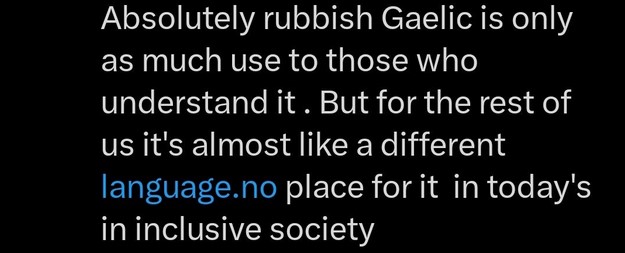
Absolutely rubbish Gaelic is only as much use to those who understand it . But for the rest of us it's almost like a different language.no place for it in today's in inclusive society [sic]

how on earth do you arrive at this conclusion?? "society needs to be inclusive which means we need to get rid of minority languages".

why are we, as minority cultures, supposed to give up our languages and cultures so that people who refuse to care about us can feel "included"?? it's like those absolutely ridiculous takes that scotland/wales/etc having minority languages and wanting independence "only serves to divide us" and "we need to focus on our similarities and not our differences". differences are good and should be celebrated, not squashed out in order to create some sort of sanitised "inclusivity".

why should we need to make members of majority cultures feel included when they say things like this about us?? we are obviously going to purposely exclude you when you're acting so mean and vile like this. why can't you learn about our languages and cultures and take part in them and be included in them?? i think most speakers of minority languages in britain would be happy to hear you're learning our languages. why don't you broaden your horizons and include yourselves into more languages, instead of deciding that an "inclusive society" means we need to give up everything so we can all be like you. different cultures/languages/etc are good. i don't understand how people will say they want an inclusive society, and then it turns out they mean cultural genocide. how are we as minority cultures meant to feel included??

also "it's almost like a different language".... uh yeah, because it IS a different language.. what on earth am i supposed to say to that..

and "gaelic is only as much use to those who understand it" yeah i feel like english is also only of use to people who understand it?? couldn't you say that about every language??

smmg: An illustration of a peacock from the Book of Kells (Default)
leaving the uk is something i've considered for a couple of years now bc of transphobia but i just don't know where's better and i'm so scared. i'm eligible for irish citizenship but i didn't think ireland was much better than the uk. i doubt i'd have the money to leave anyway. and if i move outside of the uk and ireland (places where most of my family are) then i'll have to support myself on my own, which is impossible bc of my health. i mean i have some family in canada and the usa, but i know the usa's not great for trans rights, but i think canada might be better?? but it's just so far away and i've only met my family from there like twice.

i've never been outside of the uk and ireland. and what if the place i move to has an increase in transphobia after i move there. and i'd be leaving the celtic nations which feels wrong as a celtic studies student. like my my main special interest is centered around languages from here, and going further into continental europe, which i feel is a more likely destination than canada, would mean i wouldn't get to speak welsh or the other celtic languages and wouldn't be a part of celtic language communities irl anymore (i doubt i'd move to brittany, i have a feeling france isn't great for trans stuff??). and i get really awfully homesick anyway, especially as someone with a complicated relationship to the concepts of "home" and "belonging", and to wales and the 3 places my family are from (cornwall, scotland, and ireland). i don't know how i can just leave that all behind. i feel like i'd be giving up my identity as part of multiple minority cultures and as a speaker of minority languages. it's likely i'd still end up speaking english wherever i go bc it's fucking unavoidable, but i feel like i'd lose so much connection to wales and my family and cultures and heritage. i don't know. i've already grown up disconnected from the culture of where i'm from and the cultures of my family. i don't want to disconnect myself further.

not to mention the disability side of things, it's no good moving somewhere with trans rights if i can't get good help/treatment/benefits for my disabilities.

i was reading articles about english trans people moving abroad, and i don't think they realise how lucky they are in terms of the language side of things. they've obviously had to start learning new languages from the places they've moved to, but there are english speakers all over the world so they're never particularly isolated or disconnected from the english-speaking world.

and tbh you could probably say something similar for speakers of all non-minoritised languages. the issue with welsh is that obviously i would be in a minority speaking it abroad, but it's still very much a minoritised language in the country it's from. i'm not sure that english people realise that - while they still may have some issues with language barriers while living abroad - their language has such a global presence bc of colonialism, and it's not minoritised in the country it's from. obviously i'm not defending colonialism iam just saying that it has made it fairly easy for english-speakers to live pretty much wherever in the world they want without disconnecting and isolating themselves from english-speaking communities. i don't have that as a speaker of minority languages (i suppose there's y wladfa in argentina but i don't know what their trans/disability rights and stuff are like. or there's a gaeltacht in canada somewhere i believe?? but you know what i mean - there are those specific places, it's not like everywhere. and as for cornish and scots i have no idea. i highly doubt cornish has much of a presence at all outside of cornwall/the uk). and it's bc of that colonialism that my family languages are minoritised and that i grew up disconnected from my cultures. maybe i would have an easier time thinking about moving abroad if it wasn't for that. i want to be a part of the revitalisation and continued use of these languages, and i feel like i couldn't do it from so far away.

but then what should i prioritise?? my transness, my being a part of a minority culture(s), or my health as a disabled person?? it seems wherever i live that i can't have all 3. but i don't want to give up any of them. this is so naïve but i just wish the world was a fairer place.

smmg: An illustration of a peacock from the Book of Kells (Default)
First of all, "Celtic blood" and "Celtic DNA" are not something that exist. Quite frankly, that is a white supremacist idea (unfortunately a lot of those seem to get into Celtic-related spaces...)

At it's most sinister, blood percentage is used in places like America to rob Native peoples of their Native identifies if they have below a certain percentage of Native ancestry. Regardless of if they've lived their entire lives brought up by other Native Americans and are very much a part of their culture. The ultimate aim of this is to completely erase Native American cultures, languages, histories, and anyone who identifies with them. Which is genocide.

I won't tolerate those kinds of people who love to talk about their "Celtic warrior blood" or whatever when that ideology lines up with fascism and eugenics.

Your lived experiences with a culture are what make you a part of said culture, not what's in your DNA. Modern Celtic identity is based on the presence of a modern Celtic language, not on DNA.

It is very frustrating when I see Celtic diasporas (mostly Irish/Scottish diasporas in America) claim they're allowed to call themselves Irish because they have "10.5% Irish blood" or whatever, but then turn around and say that immigrants who actually live in Ireland are not really Irish, or that the children of immigrants who have lived in Ireland their whole lives aren't really Irish either.

I identify as Welsh because I was born and raised in Wales. Quite frankly, it would be weird if I didn't identify with the country I've lived in my whole life. But that doesn't mean I can't also identify with my family's cultures. My family are Cornish, Scottish, and Irish, and I identify as Cornish/Scottish/Irish diaspora because I was raised by my family from those places. I do not identify with those places because of my "blood percentage".

My mam is from Scotland and has an Irish mother and a Scottish father. She also identifies as Welsh because she lives in Wales and it's her home. She has a right to learn Welsh and to call herself Welsh. I also have family in Wales who weren't from Wales originally, and who still don't identify as Welsh. And that is entirely their own choice.

I also have an English great-great-grandfather and an Ulster Scots great-great-grandfather. Whatever "percentage English" or "percentage Ulster Scots" that makes me, I don't care. My English and Ulster Scots ancestors passed away long before I was born. I wasn't raised by them and I don't identify with those cultures. I identify as having English and Ulster Scots heritage, because they are undeniably part of my family history, although they are not really that relevant to me. My English great-great-grandfather moved to Ireland after the famine, and my Ulster Scots great-great-grandfather moved to Scotland around a similar time. Obviously this was long before I was born, and I didn't know them at all. I haven't had any relatives in Northern Ireland since pre-partition, and the culture of the north has changed a lot since then, and I'm not going to claim I somehow have innate knowledge or am some sort of authority on modern things like the Troubles.

The Celtic Nations and languages are for everyone, whether they were born here or if they chose to make a Celtic Nation their home later in life.

We can't cry about how we are oppressed, and then turn around and act absolutely vile towards other minorities.

We can't cry about how hardships in our Celtic Nations forced people to emigrate to other countries, and then turn around and get angry at immigrants coming to the Celtic Nations who are also looking to escape hardships in their home countries.

How hypocritical is that?

My mam's side of the family have only been in Wales since the mid-1980's, and my dad moved later, but because I am white I am seen to "belong" to Wales more than non-white people. I know non-white people who are first language Welsh speakers and whose families have been in Wales for much longer than mine. But their Welshness is brought into question a lot more than mine is. Both them and me are Welsh. Someone who moves to Wales tomorrow and makes this country their home is also Welsh and belongs here just as much as the rest of us.

Although I have had the odd person be weird to me about my cultural background, it's not anything like what I've seen non-white Welsh people receive. It puzzles me how other white people in Celtic Nations can claim they experience racism, when surely they can clearly see how much worse non-white people in Celtic Nations get treated. Do they forget the word xenophobia exists? Or even anti-Irish sentiment or Celtophobia? At worse, white Celtic people claiming they experience racism are actively making it harder for non-white Celtic people to talk about their experiences of racism within the Celtic Nations (that they receive from white Celtic people).

How are you not aware of what other people in your own country are experiencing? Are you really such a self-centred hypocrite that you'll (rightfully) complain about how people ignore the oppression that Celtic Nations and Celtic languages have faced, but then ignore minorities within our nations who are also suffering?

And what does "(whatever)% blood" actually mean practically for you? Culture isn't passed down through DNA, it's something you usually learn from the people raising you (and the country you live in, if the county's culture is different to your family's). A couple of times I've had people tell me I'm not really Welsh even though I've lived my entire life here, just because I was the first person in the family born in Wales. The blood percentage model leaves no room for my Welshness and my lived experience being raised in Wales, just because I'm not "ethnically Welsh".

When I get called "half-Cornish" because my dad is from Cornwall, what does that even mean? Which half of me? People with multiple cultural identities like me should be celebrating them all, not splitting ourselves in to fractions and percentages. We should be celebrating our abundance of cultural experiences and connections, both to the place we're from and the places our families are from.

If you are a member of any Celtic diaspora and want to identify with that place, then go ahead, but you need to actually put in the work to be part of that culture. Learn the history and the language, read the literature, and very importantly learn about the modern culture of that place especially if you have no living relatives from there. The culture will have changed a lot if your ancestors emigrated 100 years or 200 years or however long ago.

Don't just say you're Irish-American/Scottish-American/etc as some sort of claim of being a minority, while putting in absolutely no effort to be a part of or to help save that oppressed culture that you claim to care about. Being a part of a culture means that you have to do the difficult things that are also part of it, not just the easy things that benefit you or that you can use to seem more "interesting" or "exotic" or "minoritised" or whatever.

Profile

smmg: An illustration of a peacock from the Book of Kells (Default)
S.H.M. Mac Giolla Íosa Gilbert

April 2026

S M T W T F S
    1234
567 8 9 1011
12131415161718
19202122232425
2627282930  

Syndicate

RSS Atom

Tags

Style Credit

Expand Cut Tags

No cut tags
Page generated Apr. 16th, 2026 02:08 pm
Powered by Dreamwidth Studios