![[personal profile]](https://www.dreamwidth.org/img/silk/identity/user.png)
It is sort of fascinating (and extremely frustrating) to me how some people just can't seem to conceive of Cornish people just like existing...? Multiple times I've had someone go "Oh you're learning Cornish? Wow that's niche, how on earth did you ever learn that Cornish existed in the first place?" like my father is literally from Cornwall, there was never a single moment when I learned that Cornish existed because it has always had a presence in my life (even though no one in my family is fluent). It's just a normal thing to me and plenty of other people, and not a strange, niche, "exotic" thing. Some of us have known about these "niche minority cultures" our whole lives because our literal family who raised us are from them. Even in Celtic studies spaces people forget about Cornwall and act like this. What's going on!!!


Do we need to rename the "British Isles"?
May. 16th, 2025 06:42 pmAs I understand it, "British" in its original use simply referred to the peoples who spoke "British" and their language (British/Common Brittonic was the ancestor of Welsh, Breton, Cornish, and Cumbric). The largest island in this archipelago became known as Britain since it was the place where the Britons (British-speaking) peoples lived, and was called "Great Britain" in order to distinguish it from Brittany on the European continent, where Brittonic-speaking peoples migrated to and where their language evolved into Breton. Brittany is actually called "Little Britain" in Scottish Gaelic: A' Bhreatann Bheag. And Wales is also "Little Britain" in Irish: An Bhreatain Bheag.
When the Germanic dialects of the Angles, Saxons, and Jutes, and Old Irish came to Great Britain, "British" was still only used to refer to the Brittonic-speaking peoples. After the Acts of Union in the 1700s, the term "British" came to be used by all the inhabitants of the island of Great Britain to refer to themselves, and became a political identifier, rather than an ethnic/linguist one.
Because of the oppression and Anglicisation of the non-English nations of these islands at the hands of the English, I (and others) feel like "British" has basically become a synonym for "English", and the cultures/languages/histories of the non-English nations are erased by labelling them as "British" too. When people talk about "Britain" they are usually only talking about England, and rarely also about Ireland, Scotland, Wales, Cornwall, the Isle of Mann, and the Channel Islands (and when people online talk about "British accents" they are usually talking about one specific, upper-class English accent. But regional/class-based accents and classism are a topic for another day). Outside of these islands, Britain and England seem to be basically viewed as one and the same. Other people seem unaware of a number of the minoritised cultures here and our histories and struggles.
Because of this conflation of the terms "English" and "British", there has been more and more talk about renaming the "British Isles" to something with less political or colonial connotations. The "Atlantic Archipelago" is something I've seen a number of times in academia, although I've yet to see it be used outside of academic scenarios. The main issue I can think of is that there are other archipelagos in the Atlantic Ocean.
What are some other alternatives? The North Sea Archipelago? There are other archipelagos in the North Sea. The Celtic Archipelago? England is not a The Celtic nation, and Brittany (which is a Celtic nation) is not in the archipelago. The Irish Archipelago? After all, the islands do surround the Irish Sea. The Dogger Archipelago? I think that might be my favourite (but I think Doggerland is very cool and interesting so maybe I'm biased). But why do we need to rename the British Isles at all?
Why do we still all need to be grouped together in that way? As previously mentioned, when people talk about "Britain" they are, 9 times out of ten, actually talking just about England. If we were to rename our islands to "the Atlantic Archipelago" then I feel like this same issue would persist, just under a new name. Maybe instead we should just change the way we talk about ourselves. If you are just talking about England, then just say England. If you're not sure what you're saying applies to just England or elsewhere in the isles too (because we each have our own laws, cultures, history, etc.) then perhaps just do a bit of research to find out, rather than just assuming that because something happens in England then it must be uniform across the islands.
I think "British Isles" is a bad term that we need to retire, but I'm not entirely sure we need to replace it with anything or to continuously lump ourselves in with our oppressors in our day-to-day language.
When the Germanic dialects of the Angles, Saxons, and Jutes, and Old Irish came to Great Britain, "British" was still only used to refer to the Brittonic-speaking peoples. After the Acts of Union in the 1700s, the term "British" came to be used by all the inhabitants of the island of Great Britain to refer to themselves, and became a political identifier, rather than an ethnic/linguist one.
Because of the oppression and Anglicisation of the non-English nations of these islands at the hands of the English, I (and others) feel like "British" has basically become a synonym for "English", and the cultures/languages/histories of the non-English nations are erased by labelling them as "British" too. When people talk about "Britain" they are usually only talking about England, and rarely also about Ireland, Scotland, Wales, Cornwall, the Isle of Mann, and the Channel Islands (and when people online talk about "British accents" they are usually talking about one specific, upper-class English accent. But regional/class-based accents and classism are a topic for another day). Outside of these islands, Britain and England seem to be basically viewed as one and the same. Other people seem unaware of a number of the minoritised cultures here and our histories and struggles.
Because of this conflation of the terms "English" and "British", there has been more and more talk about renaming the "British Isles" to something with less political or colonial connotations. The "Atlantic Archipelago" is something I've seen a number of times in academia, although I've yet to see it be used outside of academic scenarios. The main issue I can think of is that there are other archipelagos in the Atlantic Ocean.
What are some other alternatives? The North Sea Archipelago? There are other archipelagos in the North Sea. The Celtic Archipelago? England is not a The Celtic nation, and Brittany (which is a Celtic nation) is not in the archipelago. The Irish Archipelago? After all, the islands do surround the Irish Sea. The Dogger Archipelago? I think that might be my favourite (but I think Doggerland is very cool and interesting so maybe I'm biased). But why do we need to rename the British Isles at all?
Why do we still all need to be grouped together in that way? As previously mentioned, when people talk about "Britain" they are, 9 times out of ten, actually talking just about England. If we were to rename our islands to "the Atlantic Archipelago" then I feel like this same issue would persist, just under a new name. Maybe instead we should just change the way we talk about ourselves. If you are just talking about England, then just say England. If you're not sure what you're saying applies to just England or elsewhere in the isles too (because we each have our own laws, cultures, history, etc.) then perhaps just do a bit of research to find out, rather than just assuming that because something happens in England then it must be uniform across the islands.
I think "British Isles" is a bad term that we need to retire, but I'm not entirely sure we need to replace it with anything or to continuously lump ourselves in with our oppressors in our day-to-day language.
England vs Britain
Aug. 29th, 2024 10:15 amI feel like it would be so much easier to talk about Celtic nations online if the general internet population understood that England ≠ Britain ≠ the UK ≠ the British Isles.
I remember someone I followed on Tumblr received an ask where the asker was going "I thought Welsh people were English because I thought England was the island, and Britain was the country with London etc".
I also feel like since there's been Welsh, Scottish, and Cornish people online recently saying "don't say Britain when you mean England", some people have taken that to mean "never say Britain and only say England", when we just mean "stop talking about Britain like it's one homogenised culture where everywhere is England".

'British culture'
Aug. 28th, 2024 10:43 amI'm not really interested in engaging with anything where "British" is:
1: Although personally I think we should retire those geographical uses since they're just not politically neutral terms, and at worst have connotations of cultural genocide of the non-English nations of these isles at the hands of the English, and making us all "British". Think of that quote "Britishness is a political synonym for Englishness which extends English culture over the Scots, the Welsh, and the Irish". And I would add that the Cornish could very well do with being added to that quote.
- Treated like one homogenised culture (that homogenised culture ALWAYS being English and ignoring the minority languages/cultures/nations here). And...
- It's completely ignored that the modern usage of "British" is very much a political term that begun existence with the Acts of Union. I.e., not the usage that just implies Britain as an island, or the "British Isles"1, or British being used to mean Common-Brythonic-speaking peoples and their language.
1: Although personally I think we should retire those geographical uses since they're just not politically neutral terms, and at worst have connotations of cultural genocide of the non-English nations of these isles at the hands of the English, and making us all "British". Think of that quote "Britishness is a political synonym for Englishness which extends English culture over the Scots, the Welsh, and the Irish". And I would add that the Cornish could very well do with being added to that quote.

Link round-up #1
Aug. 19th, 2024 05:41 pmThis one's going to be fairly short - but I want to start posting links to articles I've read in the last week, relating to the Celtic nations, that I've enjoyed or found interesting!! Hopefully future posts will have more links.
Links re: the recent far-right riots across the UK:
- The fading Welsh accent, and does it even matter?
- ‘It’s just a rich man’s playground now’: how St Ives became patient zero of British overtourism
- A Protracted Struggle For Minority Language
- Being the Bitch - Bos an Ast
Links re: the recent far-right riots across the UK:

Disrespect for your own culture
Jun. 25th, 2024 04:29 pmthere's been a number of articles on various news sites recently about cornish language revival and there's always comments like "i'm cornish and i don't care" "i live in cornwall and this isn't interesting to me" "i'm from cornwall and the cornish language is useless" etc etc. like christ it drives me insane. the absolute apathy. the disrespect/ignorance for your own language/culture/history. idk. i guess they just haven't decolonised their way of thinking but still. insanely frustrating.
i know there's a lot of english people living in cornwall who've displaced the actual cornish population (which has happened with my own cornish family members), so maybe that's a factor in it?? i.e. english people living in cornwall who just see it as a "beautiful sunny holiday retreat", or just another part of england and english culture, or whatever. but regardless, if you've moved somewhere with a minority culture i think you should also want to take interest in it at least a little bit?? especially like if you're from the place that has oppressed that minority culture for 100s of years, i think you should at least learn a bit about that culture's history and the damage that's been done to it etc.
idk. very frustrating.
leaving the uk is something i've considered for a couple of years now bc of transphobia but i just don't know where's better and i'm so scared. i'm eligible for irish citizenship but i didn't think ireland was much better than the uk. i doubt i'd have the money to leave anyway. and if i move outside of the uk and ireland (places where most of my family are) then i'll have to support myself on my own, which is impossible bc of my health. i mean i have some family in canada and the usa, but i know the usa's not great for trans rights, but i think canada might be better?? but it's just so far away and i've only met my family from there like twice.
i've never been outside of the uk and ireland. and what if the place i move to has an increase in transphobia after i move there. and i'd be leaving the celtic nations which feels wrong as a celtic studies student. like my my main special interest is centered around languages from here, and going further into continental europe, which i feel is a more likely destination than canada, would mean i wouldn't get to speak welsh or the other celtic languages and wouldn't be a part of celtic language communities irl anymore (i doubt i'd move to brittany, i have a feeling france isn't great for trans stuff??). and i get really awfully homesick anyway, especially as someone with a complicated relationship to the concepts of "home" and "belonging", and to wales and the 3 places my family are from (cornwall, scotland, and ireland). i don't know how i can just leave that all behind. i feel like i'd be giving up my identity as part of multiple minority cultures and as a speaker of minority languages. it's likely i'd still end up speaking english wherever i go bc it's fucking unavoidable, but i feel like i'd lose so much connection to wales and my family and cultures and heritage. i don't know. i've already grown up disconnected from the culture of where i'm from and the cultures of my family. i don't want to disconnect myself further.
not to mention the disability side of things, it's no good moving somewhere with trans rights if i can't get good help/treatment/benefits for my disabilities.
i was reading articles about english trans people moving abroad, and i don't think they realise how lucky they are in terms of the language side of things. they've obviously had to start learning new languages from the places they've moved to, but there are english speakers all over the world so they're never particularly isolated or disconnected from the english-speaking world.
and tbh you could probably say something similar for speakers of all non-minoritised languages. the issue with welsh is that obviously i would be in a minority speaking it abroad, but it's still very much a minoritised language in the country it's from. i'm not sure that english people realise that - while they still may have some issues with language barriers while living abroad - their language has such a global presence bc of colonialism, and it's not minoritised in the country it's from. obviously i'm not defending colonialism iam just saying that it has made it fairly easy for english-speakers to live pretty much wherever in the world they want without disconnecting and isolating themselves from english-speaking communities. i don't have that as a speaker of minority languages (i suppose there's y wladfa in argentina but i don't know what their trans/disability rights and stuff are like. or there's a gaeltacht in canada somewhere i believe?? but you know what i mean - there are those specific places, it's not like everywhere. and as for cornish and scots i have no idea. i highly doubt cornish has much of a presence at all outside of cornwall/the uk). and it's bc of that colonialism that my family languages are minoritised and that i grew up disconnected from my cultures. maybe i would have an easier time thinking about moving abroad if it wasn't for that. i want to be a part of the revitalisation and continued use of these languages, and i feel like i couldn't do it from so far away.
but then what should i prioritise?? my transness, my being a part of a minority culture(s), or my health as a disabled person?? it seems wherever i live that i can't have all 3. but i don't want to give up any of them. this is so naïve but i just wish the world was a fairer place.

Tags:
'The Celtic gobbledygook of Kernow'
Jun. 2nd, 2024 06:00 pm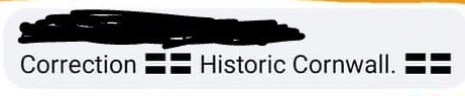
Correction 〓〓 Historic Cornwall. 〓〓
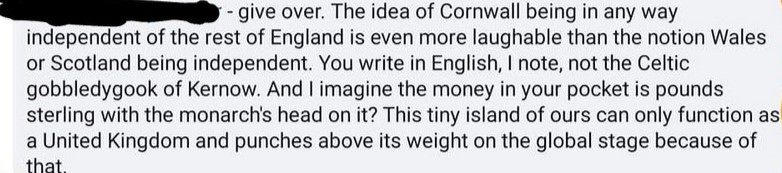
give over. The idea of Cornwall being in any way independent of the rest of England is even more laughable than the notion Wales or Scotland being independent. You write in English, I note, not the Celtic gobbledygook of Kernow. And I imagine the money in your pocket is pounds sterling with the monarch's head on it? This tiny island of ours can only function as a United Kingdom and punches above its weight on the global stage because of that.
my lord people like this drive me insane. whose fault's that that most cornish people can't speak cornish? which country and language has displaced and eradicated cornish?? you can't erase our languages and cultures and then turn around and tell us that our want for independence is invalid bc we don't have a distinct language or culture - we did, but you destroyed it, and now we have to rebuild it. and i suspect that if that person had commented in cornish, then there'd be people telling them to instead "speak the king's english" or whatever nonsense because the comment is on an english language post. and honestly it makes sense to reply in english considering the original post is in english. lots of us who can speak our celtic languages often don't use them on the internet bc a lot of the internet is in english, and if we want people to understand the corrections we make (like in the screenshot) then unfortunately we're only going to be understood and heard if we use english.
and the uk very much does not "function" if you actually open your eyes and pay attention to those of us outside of england. subjugating the non-english nations/peoples/languages does not make the uk "function". i hope the uk collapses within my lifetime, godbless. and i feel like the uk "punching above its weight on the global stage" is not great either and not something to be proud of or to want, when i feel like it "punching above its weight" definitely includes things like colonialism.

English ignorance of Cornwall
May. 11th, 2024 12:01 pmi've probably said this before but it's so absolutely crushing when i talk to english people and they have no idea that cornwall has a separate culture and language. like they don't even know we exist. and sometimes they laugh about their ignorance like "haha i didn't even know cornwall has it's own language, let alone that it's a celtic nation". sorry but it makes me a little insane. like as someone who is cornish diaspora who lives in wales bc my cornish family have largely been displaced from their homes by english tourists/second home owners, and moving for better job/education opportunities. it's so insulting and depressing. every time i meet an english person at university and we talk about our degrees i'm always mentally preparing myself for this conversation. it's so exhausting. can't necessarily blame them either bc i know their country does not teach about what they've done to cornwall, wales, etc. but why joke about your ignorance. ''i'm from england and i didn't even know about cornwall having a distinct culture hehe'' ok but why. do you never bother to learn things about the world on your own. do you ever wonder why cornwall has one of the highest poverty rates in the uk and why people are so angry about tourism and second homes there? i'm sorry but like. do you never listen to/read/watch the news. sorry it's just absolutely infuriating.
Brief explanation of some Celtic terms
Jan. 16th, 2024 07:19 pmthere are 6 modern celtic languages spoken today, which can be divided into 2 branches: goidelic/gaelic and brittonic/brythonic.
the goidelic/gaelic languages:
**scottish gaelic can just be called gaelic, which helps distinguish it from scots (a germanic language related to english with different varieties spoken in scotland and ulster). scots is not a celtic language so it isn't related to scottish gaelic, but nevertheless people still get them confused with each other.
the brittonic/brythonic languages:
other points:
along with scots and ulster scots, there are a number of non-celtic minority languages that are spoken in the celtic nations, including british sign language, irish sign language, shelta, angloromani, welsh kalá, scots-romani, and gallo (in brittany). and near-by on the channel islands, there's also guernésiais, jèrriais, and sercquiais. historically, auregnais was also spoken on the channel island alderney; norn in the shetland and orkney islands; and yola and fingallian in ireland.
the goidelic/gaelic languages:
- gaeilge / gaeilg / gaeilic / gaelainn / irish / irish gaelic / gaelic*
- gàidhlig / scottish gaelic / scots gaelic / gaelic**
- gaelg / manx
**scottish gaelic can just be called gaelic, which helps distinguish it from scots (a germanic language related to english with different varieties spoken in scotland and ulster). scots is not a celtic language so it isn't related to scottish gaelic, but nevertheless people still get them confused with each other.
the brittonic/brythonic languages:
- cymraeg / welsh
- brezhoneg / breton
- kernewek / kernowek / kernûak / cornish***
other points:
- the celtic nations refers to the places where these 6 modern celtic languages are spoken: ireland, scotland, the isle of man, wales, brittany, and cornwall.
- celtic identity is very tied to the presence of a modern celtic language. there is nothing that all of the celtic nations have in common that isn't also shared by some other cultures, except for a celtic language. places without a modern celtic language are not celtic. a large part of europe and parts of west asia were celtic-speaking in the past, but it does not make them celtic now. there is no such thing as a "culturally celtic but not celtic-speaking" country/region.
- (also the hallstatt and la tène archaeological cultures and their spread cannot be reliably linked 1:1 with the spread of celtic cultures, nor can their art reliably be labelled as "celtic art")
- celtic languages and the cultures and histories attached to them are not interchangeable with each other. there is no one singular "celtic culture".
- gaelic does not mean the same thing as celtic. welsh, breton, and cornish are celtic languages, but they are not gaelic languages. "welsh gaelic" is not a thing.
along with scots and ulster scots, there are a number of non-celtic minority languages that are spoken in the celtic nations, including british sign language, irish sign language, shelta, angloromani, welsh kalá, scots-romani, and gallo (in brittany). and near-by on the channel islands, there's also guernésiais, jèrriais, and sercquiais. historically, auregnais was also spoken on the channel island alderney; norn in the shetland and orkney islands; and yola and fingallian in ireland.

Tags:
- alba,
- breizh,
- brezhoneg,
- british sign language,
- celticity,
- cymraeg,
- cymru,
- ellan vannin,
- fingallian,
- gaeilge,
- gaelg,
- gammon,
- gàidhlig,
- history,
- kernewek,
- kernow,
- medium: in english,
- normaund,
- normaund: auregnais,
- normaund: guernésiais,
- normaund: jèrriais,
- normaund: sercquiais,
- norn,
- romani,
- romani: angloromani,
- romani: scots-romani,
- romani: welsh romani,
- scots,
- teanga chomharthaíochta na h-éireann,
- yola | forth and bargy dialect,
- éire,
- îles d'la manche
Cernyweg a'i hadfywiad
Dec. 16th, 2023 11:32 amDyma addasiad fy nghyflwyniad y wnes i ar gyfer dosbarth trafod yn y brifysgol y mis 'ma.

Mae’r iaith Gernyweg yn dod o’r tafodieithoedd de-orllewinol Brythoneg, a felly, mae hi’n perthyn yn agos i Gymraeg a Llydaweg, er bod hi’n perthyn yn agosach i Lydaweg na Chymraeg. Ac mae hi’n perthyn yn llai agos i Wyddeleg, Gaeleg yr Alban, a Manaweg.
Mae Cernyweg yn cael ei wahanu i mewn yr iaith draddodiadol a’r iaith adfywiedig. Roedd yr iaith draddodiadol yn iaith gymunedol y siaradid fel iaith gyntaf yng Nghernyw ac Ynysoedd Syllan. Mae’r iaith draddodiadol yn gallu cael ei rhannu i mewn tri chyfnod – Hen Gernyweg, Cernyweg Canol, a Chernyweg Diweddar. Roedd y cyfnod Hen Gernyw o 800 i 1200, roedd y cyfnod Cernyweg Canol o 1200 i 1600, ac roedd y cyfnod Cernyweg Diweddar o 1600 i tua 1800.
Mae’r iaith adfywiedig sy gyda sawl ffurfiau y gwnaethpwyd gan sawl o bobl yn ystod y 1900au.
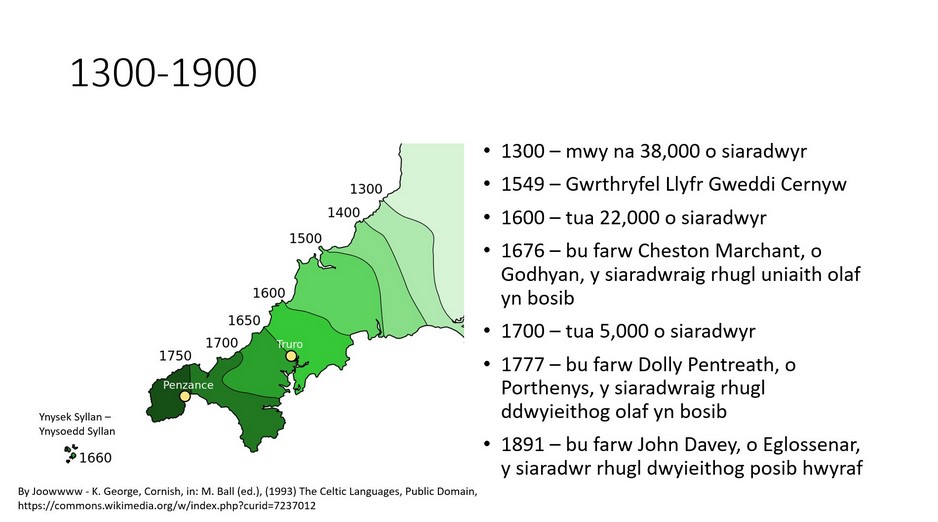
Yn 1300, roedd ‘na 38,000 o siaradwyr Cernyweg iaith gyntaf.
Roedd yr iaith Gernyweg yn dirywio’r fawr yn ystod teyrnasiad y Tuduriaid, achos o’r Diwygiad Protestannaidd. Roedd Cernyweg wedi bod yn Gatholig am y mwyaf, ac roedd y Diwygiad yn lleihau’r berthynas rhwng Cernyw â Llydaw. Hefyd, gorfodid pobl Gernyw i ddefnyddio Llyfr y Weddi Gyffredin yn Saesneg, ac i wneud popeth crefyddol yn Saesneg, ac roedd hynny’n cyfrannu’n fawr i Gernyweg yn dirywio. Roed gwrthryfel yn 1549 yn erbyn Llyfr y Weddi Saesneg, ond methodd e a lladdwyd arweinydd y gwrthryfel.
Meddylir bod Cheston Marchant yr olaf siaradwraig uniaith. Daeth hi o Godhyan (Gwithian yn Saesneg) yng ngorllewin Cernyw, a bu hi farw yn 1676. Ond, mae llawer o bobl yn meddwl bod Dolly Pentreath y siaradwraig olaf sy gyda gwybodaeth dywieithog iaith gyntaf yr iaith. Ond, dadleuir hyn gan pobl Gernyweg a sgolorion. Daeth hi o Porthenys (Mousehole), yng ngorllewin Cernyw hefyd, a bu hi farw yn 1777. Hefyd, roedd ‘na pobl eraill yn gallu siarad yr iaith, o leiaf tipyn, yn ôl rhai o bobl. Mae’n bosib bod John Davey, sy’n dod o Eglossenar (Zennor) a bu fe farw yn 1891, yn gallu siarad yr iaith yn rhugl.
Serch hynny, doedd y mwyafrif o bobl ddim yn gallu siarad Cernyweg erbyn hynny. Roedd nifer o siaradwyr wedi lleihau i 22,000 erbyn 1600, ac i 5,000 erbyn 1700.
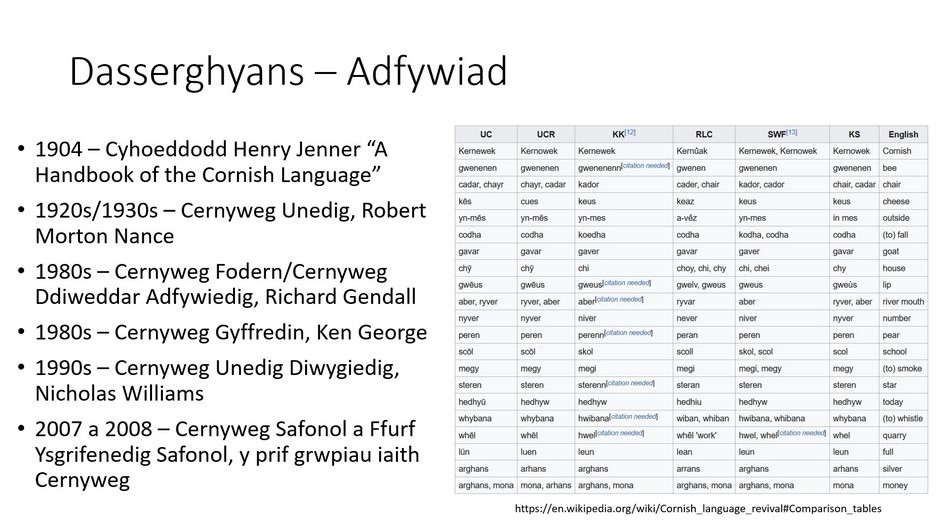
Meddylir y dechreuodd yr adfywiad yn 1904, pan cyhoeddodd Henry Jenner ei lyfr “A Handbook of the Cornish Language”.
Doedd dim modd unedig i ysgrifennu Cernyweg cyn yr adfywiad, efallai roedd ‘na chwech neu fwy. Felly roedd rhaid creu orgraff safonol wrth yr iaith yn cael ei hadfywio. Yn “A Handbook of the Cornish Language”, gwnaeth Henry Jenner geisio system sillafu gyson, yn deillio o destunau Cernyweg Canol diweddar. Ers hynny, gwnaethpwyd sawl o orgraffau, yn deillio o amrywiaeth o destunau hanesyddol a chyfnodau Cernyweg. Yn 2008, gwnaeth y prif grwpiau iaith Cernyweg wneud y Ffurf Ysgrifenedig Safonol, yn deillio o ffurfiau cynharach Cernyweg. Roedd Ffurf Ysgrifenedig Safonol yn gadael grwpiau’r iaith Gernyweg i gael arian o’r llywodraeth, ac yn gadael yr iaith i gael ei chydnabod.
Heddiw, mae’r iaith Gernyweg yn cael ei chydnabod fel iaith lleiafrifol yng Nghernyw, ond dydy hi ddim yn cael ei chydnabod fel iaith swyddogol y Deyrnas Unedig.
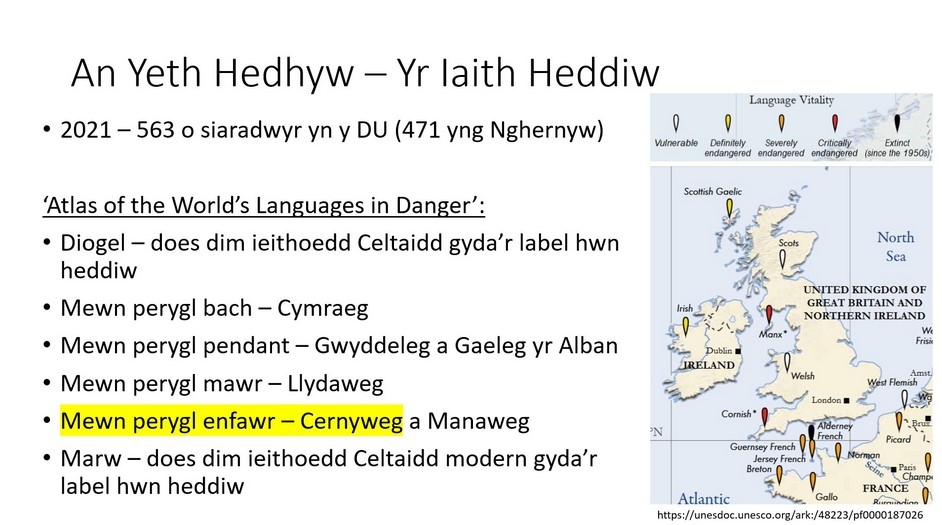
Mae’r iaith yn un o’r ieithoedd sy mewn perygl mwyaf yn y gwledydd Celtaidd. Yn 2010, cyhoeddodd UNESCO “Atlas of the World’s Languages in Danger”, ac mae’r iaith Cernyweg mewn perygl enfawr. Ond, cam enfawr y iaith ydy hyn, achos nad ydy’r iaith yn cael ei hystyried fel iaith farw’n bellach, er bod hi’n drist i ddweud bod perygl enfawr yn beth dda.
Yn ôl y cyfrifiad yn 2021, dywedodd 471 o bobl yng Nghernyw eu bod nhw’n gallu siarad Cernyweg, ac yn y Deyrnas Unedig cyfan, dywedodd 563 o bobl eu bod nhw’n gallu. Yn anfoddus, dydy hyn ddim yn llawer o siaradwyr o gwbl eto, ond mae diddordeb yn yr iaith ar gynnydd, ac roedd cynnydd bach mewn nifer siaradwyr Cernyweg ers y cyfrifiad yn 2011, felly, gobeithio bydd pethau’n gwella.
Ffynonellau
Mae’r iaith Gernyweg yn dod o’r tafodieithoedd de-orllewinol Brythoneg, a felly, mae hi’n perthyn yn agos i Gymraeg a Llydaweg, er bod hi’n perthyn yn agosach i Lydaweg na Chymraeg. Ac mae hi’n perthyn yn llai agos i Wyddeleg, Gaeleg yr Alban, a Manaweg.
Mae Cernyweg yn cael ei wahanu i mewn yr iaith draddodiadol a’r iaith adfywiedig. Roedd yr iaith draddodiadol yn iaith gymunedol y siaradid fel iaith gyntaf yng Nghernyw ac Ynysoedd Syllan. Mae’r iaith draddodiadol yn gallu cael ei rhannu i mewn tri chyfnod – Hen Gernyweg, Cernyweg Canol, a Chernyweg Diweddar. Roedd y cyfnod Hen Gernyw o 800 i 1200, roedd y cyfnod Cernyweg Canol o 1200 i 1600, ac roedd y cyfnod Cernyweg Diweddar o 1600 i tua 1800.
Mae’r iaith adfywiedig sy gyda sawl ffurfiau y gwnaethpwyd gan sawl o bobl yn ystod y 1900au.
Yn 1300, roedd ‘na 38,000 o siaradwyr Cernyweg iaith gyntaf.
Roedd yr iaith Gernyweg yn dirywio’r fawr yn ystod teyrnasiad y Tuduriaid, achos o’r Diwygiad Protestannaidd. Roedd Cernyweg wedi bod yn Gatholig am y mwyaf, ac roedd y Diwygiad yn lleihau’r berthynas rhwng Cernyw â Llydaw. Hefyd, gorfodid pobl Gernyw i ddefnyddio Llyfr y Weddi Gyffredin yn Saesneg, ac i wneud popeth crefyddol yn Saesneg, ac roedd hynny’n cyfrannu’n fawr i Gernyweg yn dirywio. Roed gwrthryfel yn 1549 yn erbyn Llyfr y Weddi Saesneg, ond methodd e a lladdwyd arweinydd y gwrthryfel.
Meddylir bod Cheston Marchant yr olaf siaradwraig uniaith. Daeth hi o Godhyan (Gwithian yn Saesneg) yng ngorllewin Cernyw, a bu hi farw yn 1676. Ond, mae llawer o bobl yn meddwl bod Dolly Pentreath y siaradwraig olaf sy gyda gwybodaeth dywieithog iaith gyntaf yr iaith. Ond, dadleuir hyn gan pobl Gernyweg a sgolorion. Daeth hi o Porthenys (Mousehole), yng ngorllewin Cernyw hefyd, a bu hi farw yn 1777. Hefyd, roedd ‘na pobl eraill yn gallu siarad yr iaith, o leiaf tipyn, yn ôl rhai o bobl. Mae’n bosib bod John Davey, sy’n dod o Eglossenar (Zennor) a bu fe farw yn 1891, yn gallu siarad yr iaith yn rhugl.
Serch hynny, doedd y mwyafrif o bobl ddim yn gallu siarad Cernyweg erbyn hynny. Roedd nifer o siaradwyr wedi lleihau i 22,000 erbyn 1600, ac i 5,000 erbyn 1700.
Meddylir y dechreuodd yr adfywiad yn 1904, pan cyhoeddodd Henry Jenner ei lyfr “A Handbook of the Cornish Language”.
Doedd dim modd unedig i ysgrifennu Cernyweg cyn yr adfywiad, efallai roedd ‘na chwech neu fwy. Felly roedd rhaid creu orgraff safonol wrth yr iaith yn cael ei hadfywio. Yn “A Handbook of the Cornish Language”, gwnaeth Henry Jenner geisio system sillafu gyson, yn deillio o destunau Cernyweg Canol diweddar. Ers hynny, gwnaethpwyd sawl o orgraffau, yn deillio o amrywiaeth o destunau hanesyddol a chyfnodau Cernyweg. Yn 2008, gwnaeth y prif grwpiau iaith Cernyweg wneud y Ffurf Ysgrifenedig Safonol, yn deillio o ffurfiau cynharach Cernyweg. Roedd Ffurf Ysgrifenedig Safonol yn gadael grwpiau’r iaith Gernyweg i gael arian o’r llywodraeth, ac yn gadael yr iaith i gael ei chydnabod.
Heddiw, mae’r iaith Gernyweg yn cael ei chydnabod fel iaith lleiafrifol yng Nghernyw, ond dydy hi ddim yn cael ei chydnabod fel iaith swyddogol y Deyrnas Unedig.
Mae’r iaith yn un o’r ieithoedd sy mewn perygl mwyaf yn y gwledydd Celtaidd. Yn 2010, cyhoeddodd UNESCO “Atlas of the World’s Languages in Danger”, ac mae’r iaith Cernyweg mewn perygl enfawr. Ond, cam enfawr y iaith ydy hyn, achos nad ydy’r iaith yn cael ei hystyried fel iaith farw’n bellach, er bod hi’n drist i ddweud bod perygl enfawr yn beth dda.
Yn ôl y cyfrifiad yn 2021, dywedodd 471 o bobl yng Nghernyw eu bod nhw’n gallu siarad Cernyweg, ac yn y Deyrnas Unedig cyfan, dywedodd 563 o bobl eu bod nhw’n gallu. Yn anfoddus, dydy hyn ddim yn llawer o siaradwyr o gwbl eto, ond mae diddordeb yn yr iaith ar gynnydd, ac roedd cynnydd bach mewn nifer siaradwyr Cernyweg ers y cyfrifiad yn 2011, felly, gobeithio bydd pethau’n gwella.
Ffynonellau
- Map y gwledydd Celtaidd
- Map Cernyw, By Joowwww - K. George, Cornish, in: M. Ball (ed.), (1993) The Celtic Languages, Public Domain
- Tabl
- Henry Jenner, ‘A handbook of the Cornish language: chiefly in its latest stages with some account of its history and literature’ (London, 1904)
- Ken George, ‘Which base for revived Cornish?’ (1995)
- Dagmar Zadražilová, ‘Revival of the Cornish language: its reasons, challenges and its relation towards the Cornish identity’ (Prague, 2010)
- UNESCO (Christopher Moseley ac Alexandre Nicolas), ‘Atlas of the world's languages in danger’ (2010)
- Office for National Statistics, 'Main language (detailed)' (2022)


