![[personal profile]](https://www.dreamwidth.org/img/silk/identity/user.png)
Saw someone complaining on Facebook (what a shocker!) the other day that if Gaelic has been made an official language of Scotland then they should also revive Pictish and make that an official language too..... if you, random person on Facebook, somehow have enough extant Pictish to be able to accurately reconstruct and revive the entire language well enough to be used in every day speech then go ahead..? I would love to see that, it would certainly solve some academic debate.


Do we need to rename the "British Isles"?
May. 16th, 2025 06:42 pmAs I understand it, "British" in its original use simply referred to the peoples who spoke "British" and their language (British/Common Brittonic was the ancestor of Welsh, Breton, Cornish, and Cumbric). The largest island in this archipelago became known as Britain since it was the place where the Britons (British-speaking) peoples lived, and was called "Great Britain" in order to distinguish it from Brittany on the European continent, where Brittonic-speaking peoples migrated to and where their language evolved into Breton. Brittany is actually called "Little Britain" in Scottish Gaelic: A' Bhreatann Bheag. And Wales is also "Little Britain" in Irish: An Bhreatain Bheag.
When the Germanic dialects of the Angles, Saxons, and Jutes, and Old Irish came to Great Britain, "British" was still only used to refer to the Brittonic-speaking peoples. After the Acts of Union in the 1700s, the term "British" came to be used by all the inhabitants of the island of Great Britain to refer to themselves, and became a political identifier, rather than an ethnic/linguist one.
Because of the oppression and Anglicisation of the non-English nations of these islands at the hands of the English, I (and others) feel like "British" has basically become a synonym for "English", and the cultures/languages/histories of the non-English nations are erased by labelling them as "British" too. When people talk about "Britain" they are usually only talking about England, and rarely also about Ireland, Scotland, Wales, Cornwall, the Isle of Mann, and the Channel Islands (and when people online talk about "British accents" they are usually talking about one specific, upper-class English accent. But regional/class-based accents and classism are a topic for another day). Outside of these islands, Britain and England seem to be basically viewed as one and the same. Other people seem unaware of a number of the minoritised cultures here and our histories and struggles.
Because of this conflation of the terms "English" and "British", there has been more and more talk about renaming the "British Isles" to something with less political or colonial connotations. The "Atlantic Archipelago" is something I've seen a number of times in academia, although I've yet to see it be used outside of academic scenarios. The main issue I can think of is that there are other archipelagos in the Atlantic Ocean.
What are some other alternatives? The North Sea Archipelago? There are other archipelagos in the North Sea. The Celtic Archipelago? England is not a The Celtic nation, and Brittany (which is a Celtic nation) is not in the archipelago. The Irish Archipelago? After all, the islands do surround the Irish Sea. The Dogger Archipelago? I think that might be my favourite (but I think Doggerland is very cool and interesting so maybe I'm biased). But why do we need to rename the British Isles at all?
Why do we still all need to be grouped together in that way? As previously mentioned, when people talk about "Britain" they are, 9 times out of ten, actually talking just about England. If we were to rename our islands to "the Atlantic Archipelago" then I feel like this same issue would persist, just under a new name. Maybe instead we should just change the way we talk about ourselves. If you are just talking about England, then just say England. If you're not sure what you're saying applies to just England or elsewhere in the isles too (because we each have our own laws, cultures, history, etc.) then perhaps just do a bit of research to find out, rather than just assuming that because something happens in England then it must be uniform across the islands.
I think "British Isles" is a bad term that we need to retire, but I'm not entirely sure we need to replace it with anything or to continuously lump ourselves in with our oppressors in our day-to-day language.
When the Germanic dialects of the Angles, Saxons, and Jutes, and Old Irish came to Great Britain, "British" was still only used to refer to the Brittonic-speaking peoples. After the Acts of Union in the 1700s, the term "British" came to be used by all the inhabitants of the island of Great Britain to refer to themselves, and became a political identifier, rather than an ethnic/linguist one.
Because of the oppression and Anglicisation of the non-English nations of these islands at the hands of the English, I (and others) feel like "British" has basically become a synonym for "English", and the cultures/languages/histories of the non-English nations are erased by labelling them as "British" too. When people talk about "Britain" they are usually only talking about England, and rarely also about Ireland, Scotland, Wales, Cornwall, the Isle of Mann, and the Channel Islands (and when people online talk about "British accents" they are usually talking about one specific, upper-class English accent. But regional/class-based accents and classism are a topic for another day). Outside of these islands, Britain and England seem to be basically viewed as one and the same. Other people seem unaware of a number of the minoritised cultures here and our histories and struggles.
Because of this conflation of the terms "English" and "British", there has been more and more talk about renaming the "British Isles" to something with less political or colonial connotations. The "Atlantic Archipelago" is something I've seen a number of times in academia, although I've yet to see it be used outside of academic scenarios. The main issue I can think of is that there are other archipelagos in the Atlantic Ocean.
What are some other alternatives? The North Sea Archipelago? There are other archipelagos in the North Sea. The Celtic Archipelago? England is not a The Celtic nation, and Brittany (which is a Celtic nation) is not in the archipelago. The Irish Archipelago? After all, the islands do surround the Irish Sea. The Dogger Archipelago? I think that might be my favourite (but I think Doggerland is very cool and interesting so maybe I'm biased). But why do we need to rename the British Isles at all?
Why do we still all need to be grouped together in that way? As previously mentioned, when people talk about "Britain" they are, 9 times out of ten, actually talking just about England. If we were to rename our islands to "the Atlantic Archipelago" then I feel like this same issue would persist, just under a new name. Maybe instead we should just change the way we talk about ourselves. If you are just talking about England, then just say England. If you're not sure what you're saying applies to just England or elsewhere in the isles too (because we each have our own laws, cultures, history, etc.) then perhaps just do a bit of research to find out, rather than just assuming that because something happens in England then it must be uniform across the islands.
I think "British Isles" is a bad term that we need to retire, but I'm not entirely sure we need to replace it with anything or to continuously lump ourselves in with our oppressors in our day-to-day language.
Anything I don't like is politics
Aug. 31st, 2024 09:18 pmi will never be able to understand people who say things like "don't bring politics into this discussion" or "don't make the situation political" etc etc. like everything is politicised whether you want it to be or not. 
Politics is a daily part of life and anything can be defined as politics if someone doesn't like who's saying it.this comment i screenshotted was in response to comments asking "why the group needed to become political" when someone asked how to say "free palestine" in scottish gaelic. because yeah politics is in everything, whether you want it to be or not. it's also especially ridiculous to be annoyed at politics in a group about scottish gaelic i.e. a minoritised language, where scottish/wider uk politics are not-infrequently brought up, including discussions around the history, oppression, and revitalisation of the language. like surely those things are all political too yes??
i think a lot about that quote (at least i think it was hozier? i cannot find a link to it now unfortunately) where he's talking about how if a teacher asks a child to draw a home, it's going to look different for each child depending on the politics that effect their life, like their cultural, ecomonic, social, etc backgrounds. some might draw a terraced house, a posh detached house, a caravan, a small flat, etc, even though they are likely not thinking about the politics of what they're drawing at all or even know a lot about politics because they're children. politics permeates everything, whether you are aware of it or not. idk it might not have been hozier and i might be misremembering the full extent of the quote, my health is bad as i'm typing this.
idk, just as someone who's part of minority cultures, disabled, and trans, i have to live every day painfully aware of how politics effects every single aspect of my life (and as a white person, although the effecst of that are in a different way to my minority identities), and it utterly astounds and bewilders me that some people are just so ignorant to the politics effecting their eveyr day experiences, decisions, and actions. and how some of them seem to choose to be ignorant by getting annoyed at anyone who tries to bring up politics.
and the number of people in that comment section going "well regardless of what you think about the situation, don't bring up politics" or "regardless of who you support, this is what the translation is..." and like no!!!! not "regardless of who you support", as a minoritised culture that's suffered at the hands of imperialism, you should be showing solidarity and support with other minoritised peoples who are suffering, yes?? as a celtic language speaker, i don't want to build a community with people who are happy to be silent on the suffering that other peoples are facing (especially as a member of a celtic nation in britain of all places, the place that issued the balfour declaration - it would be insanely hypocritical of us, surely, to cry about our own oppression but then show utter apathy to oppression that we are complicit in. arthur balfour himself was scottish and the uk prime minister at the time, david lloyd george, was welsh.)
i hate that "don't bring politics into this" basically seems to be code for "we can talk about politics and issues that we face, but not the suffering and colonisation of others bc that's Too Much. i only want to talk about things that are comfortable for me and anything i don't like is too political"

England vs Britain
Aug. 29th, 2024 10:15 amI feel like it would be so much easier to talk about Celtic nations online if the general internet population understood that England ≠ Britain ≠ the UK ≠ the British Isles.
I remember someone I followed on Tumblr received an ask where the asker was going "I thought Welsh people were English because I thought England was the island, and Britain was the country with London etc".
I also feel like since there's been Welsh, Scottish, and Cornish people online recently saying "don't say Britain when you mean England", some people have taken that to mean "never say Britain and only say England", when we just mean "stop talking about Britain like it's one homogenised culture where everywhere is England".

'British culture'
Aug. 28th, 2024 10:43 amI'm not really interested in engaging with anything where "British" is:
1: Although personally I think we should retire those geographical uses since they're just not politically neutral terms, and at worst have connotations of cultural genocide of the non-English nations of these isles at the hands of the English, and making us all "British". Think of that quote "Britishness is a political synonym for Englishness which extends English culture over the Scots, the Welsh, and the Irish". And I would add that the Cornish could very well do with being added to that quote.
- Treated like one homogenised culture (that homogenised culture ALWAYS being English and ignoring the minority languages/cultures/nations here). And...
- It's completely ignored that the modern usage of "British" is very much a political term that begun existence with the Acts of Union. I.e., not the usage that just implies Britain as an island, or the "British Isles"1, or British being used to mean Common-Brythonic-speaking peoples and their language.
1: Although personally I think we should retire those geographical uses since they're just not politically neutral terms, and at worst have connotations of cultural genocide of the non-English nations of these isles at the hands of the English, and making us all "British". Think of that quote "Britishness is a political synonym for Englishness which extends English culture over the Scots, the Welsh, and the Irish". And I would add that the Cornish could very well do with being added to that quote.

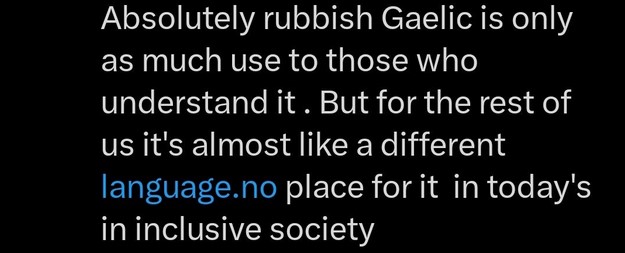
Absolutely rubbish Gaelic is only as much use to those who understand it . But for the rest of us it's almost like a different language.no place for it in today's in inclusive society [sic]
how on earth do you arrive at this conclusion?? "society needs to be inclusive which means we need to get rid of minority languages".
why are we, as minority cultures, supposed to give up our languages and cultures so that people who refuse to care about us can feel "included"?? it's like those absolutely ridiculous takes that scotland/wales/etc having minority languages and wanting independence "only serves to divide us" and "we need to focus on our similarities and not our differences". differences are good and should be celebrated, not squashed out in order to create some sort of sanitised "inclusivity".
why should we need to make members of majority cultures feel included when they say things like this about us?? we are obviously going to purposely exclude you when you're acting so mean and vile like this. why can't you learn about our languages and cultures and take part in them and be included in them?? i think most speakers of minority languages in britain would be happy to hear you're learning our languages. why don't you broaden your horizons and include yourselves into more languages, instead of deciding that an "inclusive society" means we need to give up everything so we can all be like you. different cultures/languages/etc are good. i don't understand how people will say they want an inclusive society, and then it turns out they mean cultural genocide. how are we as minority cultures meant to feel included??
also "it's almost like a different language".... uh yeah, because it IS a different language.. what on earth am i supposed to say to that..
and "gaelic is only as much use to those who understand it" yeah i feel like english is also only of use to people who understand it?? couldn't you say that about every language??

leaving the uk is something i've considered for a couple of years now bc of transphobia but i just don't know where's better and i'm so scared. i'm eligible for irish citizenship but i didn't think ireland was much better than the uk. i doubt i'd have the money to leave anyway. and if i move outside of the uk and ireland (places where most of my family are) then i'll have to support myself on my own, which is impossible bc of my health. i mean i have some family in canada and the usa, but i know the usa's not great for trans rights, but i think canada might be better?? but it's just so far away and i've only met my family from there like twice.
i've never been outside of the uk and ireland. and what if the place i move to has an increase in transphobia after i move there. and i'd be leaving the celtic nations which feels wrong as a celtic studies student. like my my main special interest is centered around languages from here, and going further into continental europe, which i feel is a more likely destination than canada, would mean i wouldn't get to speak welsh or the other celtic languages and wouldn't be a part of celtic language communities irl anymore (i doubt i'd move to brittany, i have a feeling france isn't great for trans stuff??). and i get really awfully homesick anyway, especially as someone with a complicated relationship to the concepts of "home" and "belonging", and to wales and the 3 places my family are from (cornwall, scotland, and ireland). i don't know how i can just leave that all behind. i feel like i'd be giving up my identity as part of multiple minority cultures and as a speaker of minority languages. it's likely i'd still end up speaking english wherever i go bc it's fucking unavoidable, but i feel like i'd lose so much connection to wales and my family and cultures and heritage. i don't know. i've already grown up disconnected from the culture of where i'm from and the cultures of my family. i don't want to disconnect myself further.
not to mention the disability side of things, it's no good moving somewhere with trans rights if i can't get good help/treatment/benefits for my disabilities.
i was reading articles about english trans people moving abroad, and i don't think they realise how lucky they are in terms of the language side of things. they've obviously had to start learning new languages from the places they've moved to, but there are english speakers all over the world so they're never particularly isolated or disconnected from the english-speaking world.
and tbh you could probably say something similar for speakers of all non-minoritised languages. the issue with welsh is that obviously i would be in a minority speaking it abroad, but it's still very much a minoritised language in the country it's from. i'm not sure that english people realise that - while they still may have some issues with language barriers while living abroad - their language has such a global presence bc of colonialism, and it's not minoritised in the country it's from. obviously i'm not defending colonialism iam just saying that it has made it fairly easy for english-speakers to live pretty much wherever in the world they want without disconnecting and isolating themselves from english-speaking communities. i don't have that as a speaker of minority languages (i suppose there's y wladfa in argentina but i don't know what their trans/disability rights and stuff are like. or there's a gaeltacht in canada somewhere i believe?? but you know what i mean - there are those specific places, it's not like everywhere. and as for cornish and scots i have no idea. i highly doubt cornish has much of a presence at all outside of cornwall/the uk). and it's bc of that colonialism that my family languages are minoritised and that i grew up disconnected from my cultures. maybe i would have an easier time thinking about moving abroad if it wasn't for that. i want to be a part of the revitalisation and continued use of these languages, and i feel like i couldn't do it from so far away.
but then what should i prioritise?? my transness, my being a part of a minority culture(s), or my health as a disabled person?? it seems wherever i live that i can't have all 3. but i don't want to give up any of them. this is so naïve but i just wish the world was a fairer place.

Tags:
First of all, "Celtic blood" and "Celtic DNA" are not something that exist. Quite frankly, that is a white supremacist idea (unfortunately a lot of those seem to get into Celtic-related spaces...)
At it's most sinister, blood percentage is used in places like America to rob Native peoples of their Native identifies if they have below a certain percentage of Native ancestry. Regardless of if they've lived their entire lives brought up by other Native Americans and are very much a part of their culture. The ultimate aim of this is to completely erase Native American cultures, languages, histories, and anyone who identifies with them. Which is genocide.
I won't tolerate those kinds of people who love to talk about their "Celtic warrior blood" or whatever when that ideology lines up with fascism and eugenics.
Your lived experiences with a culture are what make you a part of said culture, not what's in your DNA. Modern Celtic identity is based on the presence of a modern Celtic language, not on DNA.
It is very frustrating when I see Celtic diasporas (mostly Irish/Scottish diasporas in America) claim they're allowed to call themselves Irish because they have "10.5% Irish blood" or whatever, but then turn around and say that immigrants who actually live in Ireland are not really Irish, or that the children of immigrants who have lived in Ireland their whole lives aren't really Irish either.
I identify as Welsh because I was born and raised in Wales. Quite frankly, it would be weird if I didn't identify with the country I've lived in my whole life. But that doesn't mean I can't also identify with my family's cultures. My family are Cornish, Scottish, and Irish, and I identify as Cornish/Scottish/Irish diaspora because I was raised by my family from those places. I do not identify with those places because of my "blood percentage".
My mam is from Scotland and has an Irish mother and a Scottish father. She also identifies as Welsh because she lives in Wales and it's her home. She has a right to learn Welsh and to call herself Welsh. I also have family in Wales who weren't from Wales originally, and who still don't identify as Welsh. And that is entirely their own choice.
I also have an English great-great-grandfather and an Ulster Scots great-great-grandfather. Whatever "percentage English" or "percentage Ulster Scots" that makes me, I don't care. My English and Ulster Scots ancestors passed away long before I was born. I wasn't raised by them and I don't identify with those cultures. I identify as having English and Ulster Scots heritage, because they are undeniably part of my family history, although they are not really that relevant to me. My English great-great-grandfather moved to Ireland after the famine, and my Ulster Scots great-great-grandfather moved to Scotland around a similar time. Obviously this was long before I was born, and I didn't know them at all. I haven't had any relatives in Northern Ireland since pre-partition, and the culture of the north has changed a lot since then, and I'm not going to claim I somehow have innate knowledge or am some sort of authority on modern things like the Troubles.
The Celtic Nations and languages are for everyone, whether they were born here or if they chose to make a Celtic Nation their home later in life.
We can't cry about how we are oppressed, and then turn around and act absolutely vile towards other minorities.
We can't cry about how hardships in our Celtic Nations forced people to emigrate to other countries, and then turn around and get angry at immigrants coming to the Celtic Nations who are also looking to escape hardships in their home countries.
How hypocritical is that?
My mam's side of the family have only been in Wales since the mid-1980's, and my dad moved later, but because I am white I am seen to "belong" to Wales more than non-white people. I know non-white people who are first language Welsh speakers and whose families have been in Wales for much longer than mine. But their Welshness is brought into question a lot more than mine is. Both them and me are Welsh. Someone who moves to Wales tomorrow and makes this country their home is also Welsh and belongs here just as much as the rest of us.
Although I have had the odd person be weird to me about my cultural background, it's not anything like what I've seen non-white Welsh people receive. It puzzles me how other white people in Celtic Nations can claim they experience racism, when surely they can clearly see how much worse non-white people in Celtic Nations get treated. Do they forget the word xenophobia exists? Or even anti-Irish sentiment or Celtophobia? At worse, white Celtic people claiming they experience racism are actively making it harder for non-white Celtic people to talk about their experiences of racism within the Celtic Nations (that they receive from white Celtic people).
How are you not aware of what other people in your own country are experiencing? Are you really such a self-centred hypocrite that you'll (rightfully) complain about how people ignore the oppression that Celtic Nations and Celtic languages have faced, but then ignore minorities within our nations who are also suffering?
And what does "(whatever)% blood" actually mean practically for you? Culture isn't passed down through DNA, it's something you usually learn from the people raising you (and the country you live in, if the county's culture is different to your family's). A couple of times I've had people tell me I'm not really Welsh even though I've lived my entire life here, just because I was the first person in the family born in Wales. The blood percentage model leaves no room for my Welshness and my lived experience being raised in Wales, just because I'm not "ethnically Welsh".
When I get called "half-Cornish" because my dad is from Cornwall, what does that even mean? Which half of me? People with multiple cultural identities like me should be celebrating them all, not splitting ourselves in to fractions and percentages. We should be celebrating our abundance of cultural experiences and connections, both to the place we're from and the places our families are from.
If you are a member of any Celtic diaspora and want to identify with that place, then go ahead, but you need to actually put in the work to be part of that culture. Learn the history and the language, read the literature, and very importantly learn about the modern culture of that place especially if you have no living relatives from there. The culture will have changed a lot if your ancestors emigrated 100 years or 200 years or however long ago.
Don't just say you're Irish-American/Scottish-American/etc as some sort of claim of being a minority, while putting in absolutely no effort to be a part of or to help save that oppressed culture that you claim to care about. Being a part of a culture means that you have to do the difficult things that are also part of it, not just the easy things that benefit you or that you can use to seem more "interesting" or "exotic" or "minoritised" or whatever.
The English language and indigeneity
May. 22nd, 2024 06:28 pma strange trend i see is to call english a "non-native" or "non-indigenous" language to britain, which is bizarre as the english language very much is from britain. the english language as we know it evolved here as a distinct language from what was spoken by the anglo-saxons who settled here, so i would very much say that makes it an indigenous language. a language that is native/indigenous to britain just mean that the language originates from britain, it doesn't necessarily have to also mean that the language is marginalised. and how far back are you prepared to go before something is no longer considered native to the area? the ancestors of speakers of modern celtic languages were likely from the european continent, and even further back both english and the celtic languages come from proto-indo-european, so are none of them "really" native to britain in that case, if they have a traceable root from somewhere else?
and it's strange bc english and scots both come from the same germanic roots, but i never see anyone claiming that scots isn't actually native to britain/scotland bc of those roots. whereas some people (online and those i've talked to irl) are happy to claim that english isn't actually native to england bc it evolved from old english which ultimately evolved from the germanic languages brought over by anglo-saxons. and old english is also what scots evolved from, so scots shares those same roots.
i suppose maybe it's not that strange, bc the internet is very american, so i suppose people are taking the model of america and it's indigenous languages and applying it to britain, when it isn't exactly the same situation.
[edit: i should have clarified with that last point - in the case of somewhere like america or new zealand, their indigenous languages are all minoritised, but in somewhere like britain that is not the case.]

Brief explanation of some Celtic terms
Jan. 16th, 2024 07:19 pmthere are 6 modern celtic languages spoken today, which can be divided into 2 branches: goidelic/gaelic and brittonic/brythonic.
the goidelic/gaelic languages:
**scottish gaelic can just be called gaelic, which helps distinguish it from scots (a germanic language related to english with different varieties spoken in scotland and ulster). scots is not a celtic language so it isn't related to scottish gaelic, but nevertheless people still get them confused with each other.
the brittonic/brythonic languages:
other points:
along with scots and ulster scots, there are a number of non-celtic minority languages that are spoken in the celtic nations, including british sign language, irish sign language, shelta, angloromani, welsh kalá, scots-romani, and gallo (in brittany). and near-by on the channel islands, there's also guernésiais, jèrriais, and sercquiais. historically, auregnais was also spoken on the channel island alderney; norn in the shetland and orkney islands; and yola and fingallian in ireland.
the goidelic/gaelic languages:
- gaeilge / gaeilg / gaeilic / gaelainn / irish / irish gaelic / gaelic*
- gàidhlig / scottish gaelic / scots gaelic / gaelic**
- gaelg / manx
**scottish gaelic can just be called gaelic, which helps distinguish it from scots (a germanic language related to english with different varieties spoken in scotland and ulster). scots is not a celtic language so it isn't related to scottish gaelic, but nevertheless people still get them confused with each other.
the brittonic/brythonic languages:
- cymraeg / welsh
- brezhoneg / breton
- kernewek / kernowek / kernûak / cornish***
other points:
- the celtic nations refers to the places where these 6 modern celtic languages are spoken: ireland, scotland, the isle of man, wales, brittany, and cornwall.
- celtic identity is very tied to the presence of a modern celtic language. there is nothing that all of the celtic nations have in common that isn't also shared by some other cultures, except for a celtic language. places without a modern celtic language are not celtic. a large part of europe and parts of west asia were celtic-speaking in the past, but it does not make them celtic now. there is no such thing as a "culturally celtic but not celtic-speaking" country/region.
- (also the hallstatt and la tène archaeological cultures and their spread cannot be reliably linked 1:1 with the spread of celtic cultures, nor can their art reliably be labelled as "celtic art")
- celtic languages and the cultures and histories attached to them are not interchangeable with each other. there is no one singular "celtic culture".
- gaelic does not mean the same thing as celtic. welsh, breton, and cornish are celtic languages, but they are not gaelic languages. "welsh gaelic" is not a thing.
along with scots and ulster scots, there are a number of non-celtic minority languages that are spoken in the celtic nations, including british sign language, irish sign language, shelta, angloromani, welsh kalá, scots-romani, and gallo (in brittany). and near-by on the channel islands, there's also guernésiais, jèrriais, and sercquiais. historically, auregnais was also spoken on the channel island alderney; norn in the shetland and orkney islands; and yola and fingallian in ireland.

Tags:
- alba,
- breizh,
- brezhoneg,
- british sign language,
- celticity,
- cymraeg,
- cymru,
- ellan vannin,
- fingallian,
- gaeilge,
- gaelg,
- gammon,
- gàidhlig,
- history,
- kernewek,
- kernow,
- medium: in english,
- normaund,
- normaund: auregnais,
- normaund: guernésiais,
- normaund: jèrriais,
- normaund: sercquiais,
- norn,
- romani,
- romani: angloromani,
- romani: scots-romani,
- romani: welsh romani,
- scots,
- teanga chomharthaíochta na h-éireann,
- yola | forth and bargy dialect,
- éire,
- îles d'la manche

