smmg: An illustration of a peacock from the Book of Kells (Default)


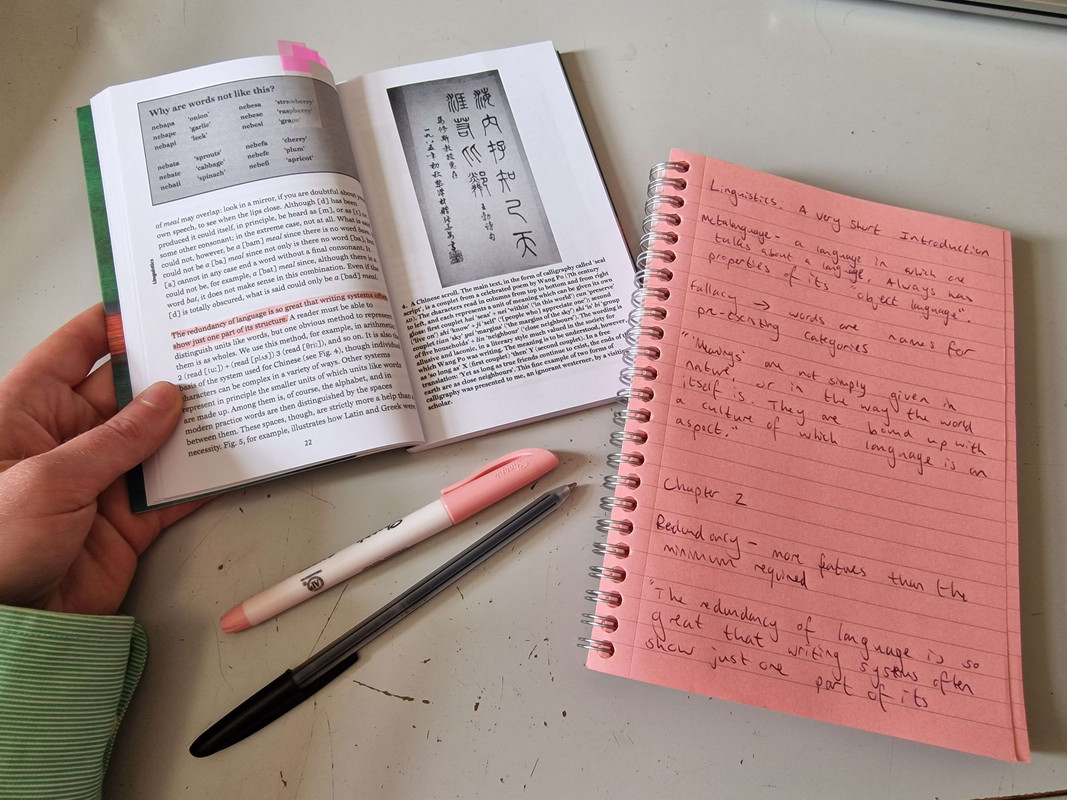
Today I read the second chapter of 'Linguistics: A Very Short Introduction' and took some notes.

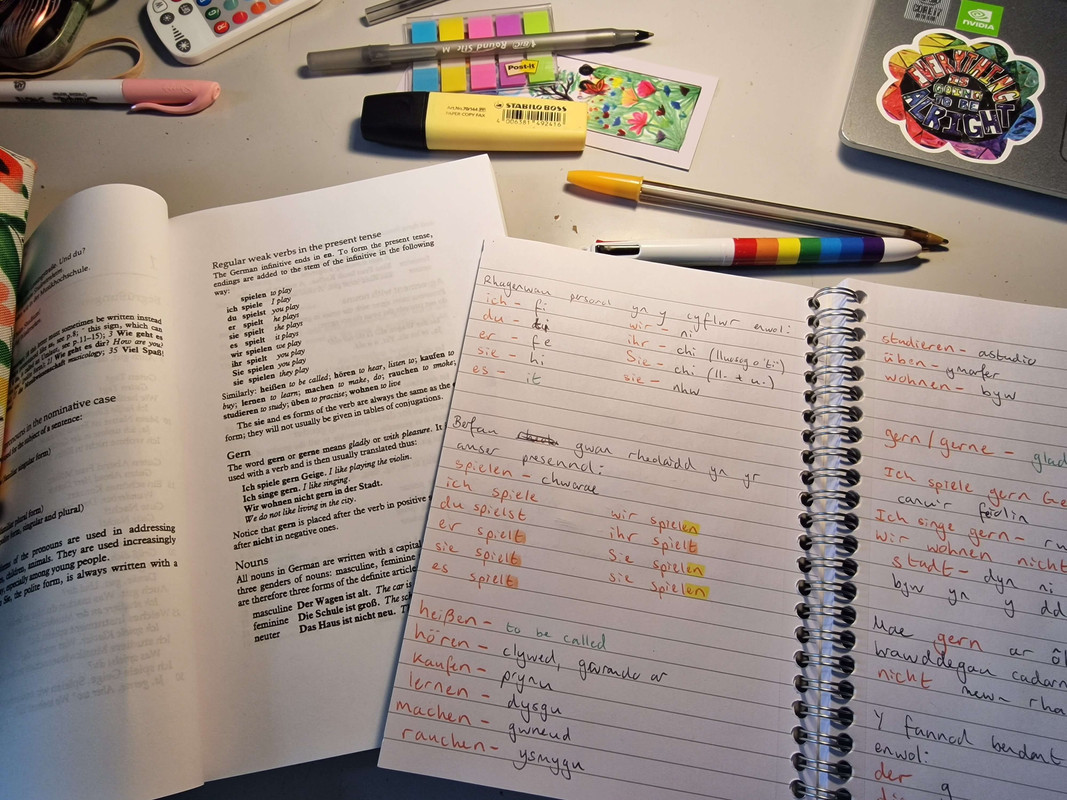
I also started on 'German for Musicians' and I've almost finished the first chapter. I'm really enjoying 'German for Musicians' so far, it's really fun to be able to combine my love for learning languages with my love for music.

smmg: An illustration of a peacock from the Book of Kells (Default)
I'm always torn between wanting to write here exclusively in Celtic languages, in somewhat of an effort to decolonise and resist anglicisation, and to write everything in English, since I also want to educate people about Celtic studies and the Celtic nations and out of all the languages I can communicate it, English is by far the most widely understood.

I suppose I could write everything bilingually in English and Welsh, or English and Irish, or English and whatever-other-language, but often I don't really have the energy for that. But I think it might be the best compromise. When educating about your own minority cultures, unfortunately a majority language (such as English) is the medium that is going to have the furthest reach and be readable by the most people and raise the most awareness. But I don't want to exclusively write in English and to reinforce English as a "default language that everyone must know", and I think using minority languages online is a good way to draw attention to them and their cultures, struggles, history, etc. So maybe writing everything bilingually is the best compromise. 
smmg: An illustration of a peacock from the Book of Kells (Default)
Coirnis

Faoi láthair, tá mé ag déanamh cúrsa bun-Choirnise ar líne. Thosaigh sé tús an míosa seo (Bealtaine), agus críochnóidh sé tús mhí Iúil. Ansin, i mí Mheán Fómhair/Deireadh Fómhair tá mé ag iarraidh an chéad rang eile a dhéanamh.


Albainis

Tá mé ag déanamh cúrsa Open University faoi láthair. Tá mé ag iarraidh é a chríochnú roimh mí Mhéan Fómhair.


Gearmáinis

Tá mé ag iarraidh rang Germáinise san ollscoill a dhéanamh, mar chuid den Theastas Ard-Oideachais i Nua-Theangacha. Rinne mé an tSínis i mbliana, ach tá mé ag iarraidh díriú ar Ghearmáinis an bhliain seo chugainn. Níl mé ag iarraidh bun-rang i deanga a dhéanamh arís, mar sin tá súil agam gur féidir liom Gearmáinis a fhoghlaim i m'aonar, agus ansin beidh mé ábalta meán-rang a dhéanamh san ollscoill.


Gaeilge

Tá mé ag iarraidh 'Basic Irish' le Nancy Stenson a chríochnú roimh tús an bhliain acadúil seo chugainn (mar sin, roimh deireadh mhí Mheán Fómhair/tús mhí Dheireadh Fómhair).


Breatnais

Tá mé ag iarraidh léamh níos mó sa mBreatnais. Freisin, beidh mé ag dul go Comhdháil Mhic Léinn na Ceiltise i mí Meithimh mar sin tá mé ag dul ag éisteacht le léachtaí sa mBreatnais.

Pondering

May. 28th, 2025 08:57 pm
smmg: An illustration of a peacock from the Book of Kells (Default)
I've decided I want to do a historiography module and the intermediate Old Irish module next year, but I can't decide on what I want the last one to be. It has to be either Scottish Gaelic language/literature/history, or one about Welsh translation and the translation industry. It doesn't necessarily matter which one I pick, because I can do the other one later on. I'm on a part-time timetable so I only get three modules a year.

The year after next, I want to do the advanced Modern Irish class, modern British and Irish politics, and comparative Celtic linguistics.

After that year, I want to do minority language preservation, literature as a source of history, and then either the Scottish Gaelic or translation depending on which on I decide to do next year.

But I can't really decide. As I'm typing this out, I'm actually thinking that I'll pick the translation one next year, and leave Scottish Gaelic until my last year. The part of the Scottish Gaelic module I'm most interested in is the history element of it, although I am interested in the language too, so maybe I'll pick the translation module and just get the reading list for Scottish Gaelic.
smmg: An illustration of a peacock from the Book of Kells (Default)
As I understand it, "British" in its original use simply referred to the peoples who spoke "British" and their language (British/Common Brittonic was the ancestor of Welsh, Breton, Cornish, and Cumbric). The largest island in this archipelago became known as Britain since it was the place where the Britons (British-speaking) peoples lived, and was called "Great Britain" in order to distinguish it from Brittany on the European continent, where Brittonic-speaking peoples migrated to and where their language evolved into Breton. Brittany is actually called "Little Britain" in Scottish Gaelic: A' Bhreatann Bheag. And Wales is also "Little Britain" in Irish: An Bhreatain Bheag.

When the Germanic dialects of the Angles, Saxons, and Jutes, and Old Irish came to Great Britain, "British" was still only used to refer to the Brittonic-speaking peoples. After the Acts of Union in the 1700s, the term "British" came to be used by all the inhabitants of the island of Great Britain to refer to themselves, and became a political identifier, rather than an ethnic/linguist one.

Because of the oppression and Anglicisation of the non-English nations of these islands at the hands of the English, I (and others) feel like "British" has basically become a synonym for "English", and the cultures/languages/histories of the non-English nations are erased by labelling them as "British" too. When people talk about "Britain" they are usually only talking about England, and rarely also about Ireland, Scotland, Wales, Cornwall, the Isle of Mann, and the Channel Islands (and when people online talk about "British accents" they are usually talking about one specific, upper-class English accent. But regional/class-based accents and classism are a topic for another day). Outside of these islands, Britain and England seem to be basically viewed as one and the same. Other people seem unaware of a number of the minoritised cultures here and our histories and struggles.

Because of this conflation of the terms "English" and "British", there has been more and more talk about renaming the "British Isles" to something with less political or colonial connotations. The "Atlantic Archipelago" is something I've seen a number of times in academia, although I've yet to see it be used outside of academic scenarios. The main issue I can think of is that there are other archipelagos in the Atlantic Ocean.

What are some other alternatives? The North Sea Archipelago? There are other archipelagos in the North Sea. The Celtic Archipelago? England is not a The Celtic nation, and Brittany (which is a Celtic nation) is not in the archipelago. The Irish Archipelago? After all, the islands do surround the Irish Sea. The Dogger Archipelago? I think that might be my favourite (but I think Doggerland is very cool and interesting so maybe I'm biased). But why do we need to rename the British Isles at all?

Why do we still all need to be grouped together in that way? As previously mentioned, when people talk about "Britain" they are, 9 times out of ten, actually talking just about England. If we were to rename our islands to "the Atlantic Archipelago" then I feel like this same issue would persist, just under a new name. Maybe instead we should just change the way we talk about ourselves. If you are just talking about England, then just say England. If you're not sure what you're saying applies to just England or elsewhere in the isles too (because we each have our own laws, cultures, history, etc.) then perhaps just do a bit of research to find out, rather than just assuming that because something happens in England then it must be uniform across the islands.

I think "British Isles" is a bad term that we need to retire, but I'm not entirely sure we need to replace it with anything or to continuously lump ourselves in with our oppressors in our day-to-day language.
smmg: An illustration of a peacock from the Book of Kells (Default)


Amserlin ar gyfer fideo rwy'n gwneud am yr iaith Gernyweg :) Rwy'n hapus iawn gyda hi, ac rwy'n mynd i wneud amserlin arall sy'n canolbwyntio ar y 20fed ganrif a'r 21ain ganrif.

smmg: An illustration of a peacock from the Book of Kells (Default)
I find it hard to engage with fantasy as a genre sometimes because of a large number of authors' treatment of Celtic cultures in their works. I think the inherent connection of our cultures with fantasy and magic is a problem, and a continuation of the Victorian-era romanticisation and othering of Celtic peoples. I do think it's a problem when aspects of Celtic cultures get inherently linked with magic and non-humans, like how dwarves in a lot of fantasy seem to get Scottish accents and often seem to be the only characters coded as Scottish within a work (The Lord of the Rings/Hobbit films spring immediately to mind). Because dwarves are often portrayed as tough, rugged warriors? A tired stereotype of Scottish people (particularly Highlanders), I feel.

But even when there is no direct connection within a text that "Celtic = magic/non-human", I still feel that the mere presence of Celtic aspects in fantasy is an inherent issue. Why is it that writers seem to subconsciously associate our cultures with fantasy? Why do our languages (or bastardised versions of them) make an appearance in fantasy, when they often do not within other genres? Why do so few authors want to use German/French/Italian/etc in their fantasy works? Why are languages like Welsh and Irish more of an "obvious" choice for them?

Why are our languages and cultures seen as inherently more easy to associate with fantasy? There is this assumption held by the general public who are not into Celtic Studies that Celtic cultures are much more "ancient" in some way than other European cultures. People assume that the ancient Celts and the modern day Celtic nations form some sort of unbroken, inherited sense of uniform Celticness, and that that gives us our cultures some sort of mythical properties because of our "unbroken link to the past" or whatever. This manifests in people assuming that we are more "primitive", and that makes us easier to fit into a medieval-style high fantasy setting. The "noble savage" stereotype of Celtic peoples. The sort of subconscious idea that we have "ancient druidic power" that makes us more "fantastical".

It's easy to poach from minoritised cultures. Few people will notice you've done it, and the few that do notice will have such a small voice compared to the majority that are indifferent. And people will defend authors' decisions to other us and even deny that Celtic languages have been used in a certain work (I'm especially thinking of fans of The Witcher... I'll likely never get into those books/games/show). It's funny to me when I see that there's a wolf/man character in Elden Ring called "Blaidd", because that just means "wolf" in Welsh. I'm sure it sounded "cool" and "fantasy" to whoever named him that, but it's just blatantly taking a very common/obvious word from a minority language because you think that no-one who plays your game will know what it means and just think it's a fantastical word. Or "Blaidd means wolf" will just be a cool bit of trivia.

Do authors who include our languages even know how to pronounce them? And if they do, does it make it better? Personally I'd still be upset if an author who spoke a Celtic language included that language in fantasy, if they were including it without thinking about how they are portraying it, or why they included a Celtic language and not, for example, a Romance language. If they included a Celtic language or culture in their work, and still fell into all the same old stereotypes of Celtic peoples, it would still be bad. To be honest, the inherent inclusion of a Celtic language in fantasy is enough to put me on edge, even if the author isn't saying that "Celtic = magic" or whatever.

I do like fantasy as a genre. I just find it hard to engage with. There are fantasy books, films, and games that I love, despite any Celtic-related flaws they may have. Their inclusion of Celtic aspects may still make me uncomfortable though, or snap me out of my experience of enjoying the work. When I was playing Arcanum: Of Steamworks and Magick Obscura in 2023, I initially found it funny that there was a kingdom called Cumbria, since that is the name of an English county that used to be Brythonic-speaking until the middle ages, and the name is related to the modern Welsh word for Wales, "Cymru". And the kingdom also had Dragon Knights, which obviously felt very Welsh. But in retrospect, I think that perhaps a political point was trying to be conveyed there, considering the fictional Cumbria's relationship to the Unified Kingdom (clearly based off the real world United Kingdom). Cumbria had been subdued by the Unified Kingdom and had parts of its territories annexed. I think maybe I'd be interested to go back at some point and examine that part in the game more closely, as an analogy for Wales and its place in the UK. So I do think Celtic peoples can be put into fantasy. I just also wonder why authors seem to have a more difficult time putting us into sci-fi, action, thriller, horror, slice-of-life, etc.

I myself have a fantasy story that I've been working on ("writing" would be an incorrect term since it's mostly note-making, and I rarely get around to actually writing anything fiction these days. A shame. I should try and get back into it...) So far I've purposefully avoided putting any characters with any Celtic names or any other Celtic-coding into my story. I would like to, but I'm not sure on the best way to go about it. I think I would be interested in writing a fantasy story that subverts all of the usual conventions of including Celtic-coded characters in fantasy. Again, I'm not sure how to do that. And I would be interested in reading fantasy by other authors from Celtic nations who want to challenge all the usual Celtic-based tropes of fantasy.

YouTube?

Apr. 13th, 2025 09:53 pm
smmg: An illustration of a peacock from the Book of Kells (Default)
I'm thinking about recording myself reading my Cornish revival post and uploading it to YouTube (with Welsh and English subtitles). I might edit it and add more information, since it was originally written for a university presentation and it had to fall within a certain time limit. Anyway, I think, at the very least, that having the information in audio format is a useful thing for accessibility. And I've been wanting to get into making YouTube videos for years now, and I've uploaded some videos of my music and playing games in the past, but I'd like to get into making videos featuring me talking, and specifically talking about Celtic Studies things, and I think that this would be a good place to start. Maybe it'll be my summer project once I'm moved into my new flat 🤔 ...
smmg: An illustration of a peacock from the Book of Kells (Default)
Like... what are we doing here...


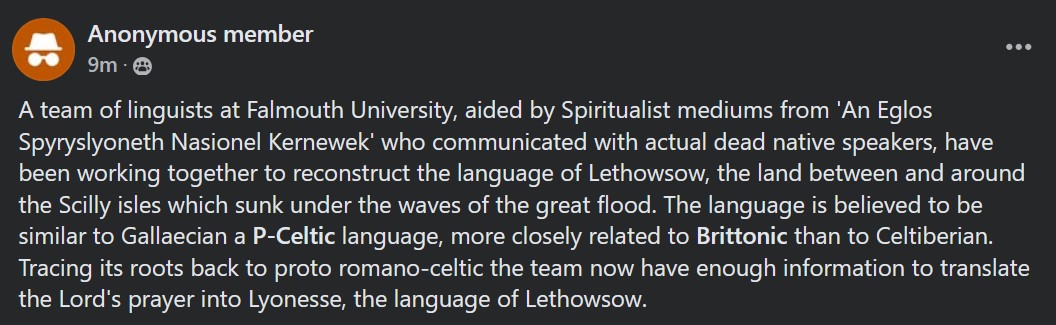
A team of linguists at Falmouth University, aided by Spiritualist mediums from 'An Eglos Spyryslyoneth Nasionel Kernewek' who communicated with actual dead native speakers, have been working together to reconstruct the language of Lethowsow, the land between and around the Scilly isles which sunk under the waves of the great flood. The language is believed to be similar to Gallaecian a P-Celtic language, more closely related to Brittonic than to Celtiberian. Tracing its roots back to proto romano-celtic the team now have enough information to translate the Lord's prayer into Lyonesse, the language of Lethowsow.
smmg: An illustration of a peacock from the Book of Kells (Default)


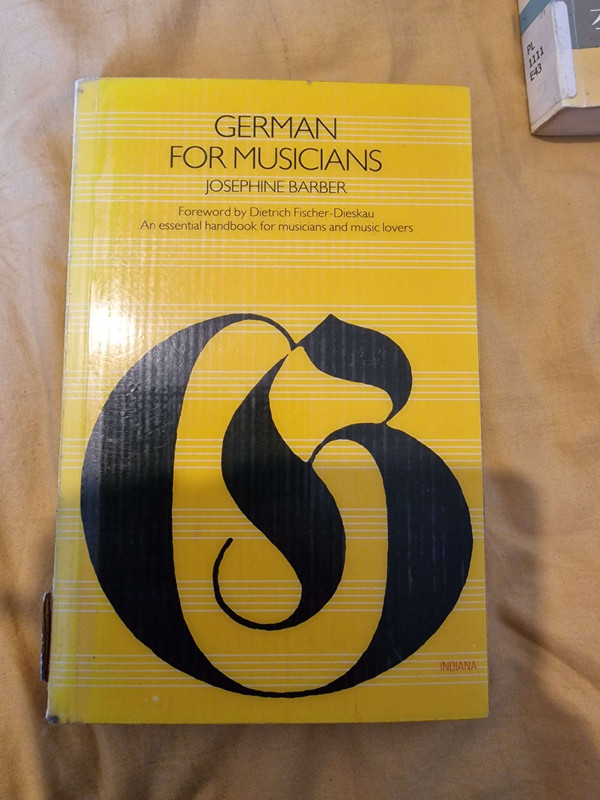
Very good find at the library today!!!! It has basic German lessons, and then goes on to focus on excerpts from operas/songs, letters written by German composers, and a glossary of German music terms. Wonder if there's something similar for Italian too....
smmg: An illustration of a peacock from the Book of Kells (Default)
Today I went to the newsagents and bought a copy of the monthly Welsh-language newspaper for my local area. I think reading the news is probably one of the best ways to improve your skills at a language, as you encounter a lot of words relating to every day happenings, current events, words relating to things going on around you, etc. And you not only get to practice your skills in a language, but also keep up with what's going on. Which is obviously useful if the newspaper is for your local area, but I think also it's useful if you're learning a language of a place that you don't live in, for the sake of keeping up with what's going on with that other place culturally, socially, politically, etc.
smmg: An illustration of a peacock from the Book of Kells (Default)
I want to do translations of articles and such more frequently, in order to learn more Welsh vocabulary relating to current events and such, and to hopefully eventually push my Welsh skills out of B2 and into C1.

Original article (bbc.co.uk/cymrufyw)
My translation

'Diwylliant gwenwynig' yn sgil cynllun i dorri swyddi ym Mhrifysgol Caerdydd
'Toxic culture' as a result of plan to cut jobs at Cardiff University
Read more... )

New words for me:
  • gwenwynig - poisonous, venomous, toxic
  • mynd i’r afael â - to come to grips with, to address
  • holi - to question, to inquire, to ask
  • hwb - a push, a thrust, a lift up, a push forward
  • rhoi hwb - to give a boost to
  • hanfodol - crucial, essential, vital
  • bygythiad - a threat, a menace
  • ymgynghori - to consult, to confer
  • terfynol - final
  • cynnig - an offer, a proposal, a motion, to offer, to aim, to threaten (I knew about the "an/to offer" meaning, but not the others)
  • uno - to amalgamate, to unite, to join
  • diswyddiad - a redundancy, a job cut
  • wrth gefn - in reserve
  • arian wrth gefn - monetary reserves
  • buddsoddiad - an investment
  • cael gwared ar - to get rid of
  • llefarydd - a spokesperson
  • diwygio - to amend, to reform, to revise
  • gweithredu - to operate, to act, to implement, to accomplish

Overall, dissapointed in the number of words I had to look up, but hopefully the more articles I read, the less I'll have to use the dictionary.
smmg: An illustration of a peacock from the Book of Kells (Default)
白日依山尽,(bái rì yī shān jìn)
黄河入海流。(huáng hé rù hǎi liú)
欲穷千里目,(yù qióng qiān lǐ mù)
更上一层楼。(gèng shàng yī céng lóu)

Machluda'r haul disglair dros y mynyddoedd pellaf,
Llifa'r Afon Felen i mewn i'r môr.
Er mwyn gweld mil milltir yn bellach,
Dringwch i fyny un llawr mwy'r tŵr.
smmg: An illustration of a peacock from the Book of Kells (Default)
My a vynn skrifya yn Gernewek pub seythen. Ny wrav vy devnydhya ow Hernewek yn fenowgh, mes my a vynn praktisya. Bedhav vy gul klass Kernewek warlinen yn mis Metheven, govenek a'm beus. Bys yn mis Metheven, yth esov vy owth assaya gwellha war ow honan.

Ny wrav vy godhvos a fedhav vy durya gul an klass Chinek yn mis Hedra. Da yw genev Chinek, mes my a vynn fogella war Gembrek, Iwerdhonek, ha Kernewek.

Ynwedh, my a vynn gallos skrifya yn Gernewek heb devnydhya an gerlyver nag ow skriflyver yn feur.
smmg: An illustration of a peacock from the Book of Kells (Default)
Seo iad mo phleananna le haighaidh foghlaim teangacha an bhliain seo agus an bhliain seo chugainn.


2025

An bhliain seo, thosaigh mé Sean-Ghaeilge i mí Eanáir, agus déanfaidh mé í an téarma seo (críochnóidh an téarma i mí Bealtaine). Is rang tosaitheoirí é, ach níl mé cinnte an féidir liom an meánrang a dhéanamh i mí Dheireadh Fómhair. Tá mé ag staidéar go páirtaimseartha anois, mar sin tá mé ag déanamh leath mo thríú bliana i 2024/2025, agus ansin tá mé ag déanamh an leath eile i 2025/2026. Níl a fhios agam an féidir liom an meánrang i 2025/2026 a dhéanamh, nó nach foláir dom a fanacht go dtí 2026/2027 (an chéad leath mo cheathrú bliana).

Tá mé ag déanamh Breatnaise agus Gaeilge fós. Tá mé ag déanamh ranganna Breatnaise san ollscoil, agus níl mé ag déanamh ranganna Gaeilge san ollscoil an téarma seo ach téim go ranganna mhic léinn eile. Bíonn mo mhúinteoirí ag múineadh i mBreatnais, mar sin is féidir liom mo Bhreatnais a chleachtadh i ngach rang. Ba mhaith liom rang aistriúchán Breatnaise a dhéanamh i mí Dheireadh Fómhair, agus beidh mé ag dul go na ranganna Gaeilge eile fós.

Tá mé ag déanamh Sínise an téarma seo, freisin. Críochnóidh na ranganna i mí Aibreáin. Ansin, i mí Bealtaine, ba mhaith liom ranganna Coirnise a thosú. Tá na ranganna ar líne. Ní maith liom ranganna ar líne a dhéanamh, ach is fearr liom a bheith ag foghlaim le rang agus múinteoir ná foghlaim i m'aonar. Tosóidh na ranganna i mí Bealtaine agus críochnóidh siad i mí Iúil.

I mí Lúnasa nó mí Mheán Fómhair, ba mhaith liom Albainis a thosú. Rinne mé beagán Albainise cheana féin, ach tá mé ag iarraidh foghlaim i gceart.


2026

Tá níos lú pleanna i 2026 agam, ach ba mhaith liom a bheith ag foghlaim Gearmáinise agus Jèrriais (Fraincis Geirsí).
smmg: An illustration of a peacock from the Book of Kells (Default)

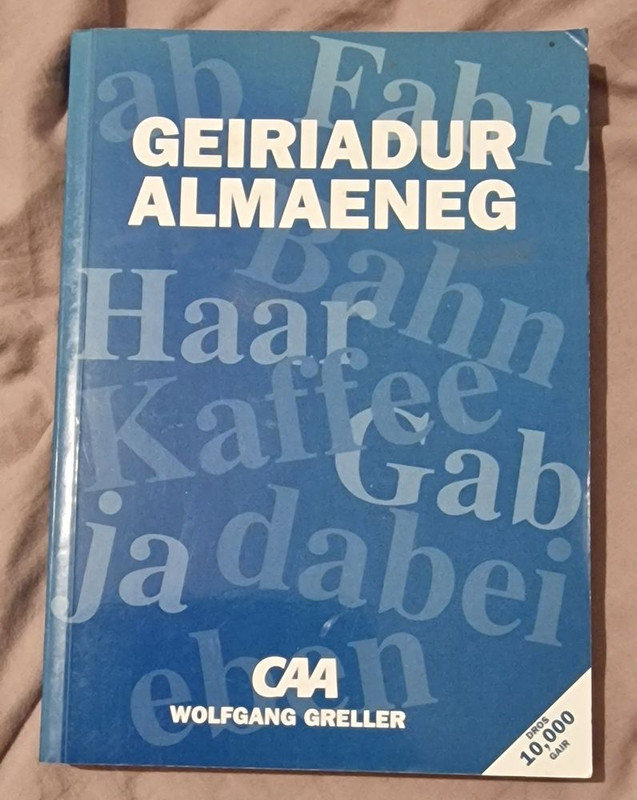
Darganfyddiad gwych mewn siop elusen. Arwydd ddylen i ddysgu Almaeneg, mae'n amlwg... (Ac mae wastad yn neis gweld geiriaduron dwyieithog heb Saesneg).


smmg: An illustration of a peacock from the Book of Kells (Default)
Dyma fy "wishlist" ieithoedd! Dyma'r ieithoedd i gyd hoffwn i ddysgu (* = ieithoedd fi'n dysgu/gwybod yn barod).
  • Cymraeg *
  • Gwyddeleg *
  • Cernyweg *
  • Scoteg (* weithiau)
  • Tsieinëeg *
  • Almaeneg
  • Jèrriais
  • Ffinneg
  • Slofaceg
  • Wcreineg
  • (Islandeg, falle...)
Sai'n credu dim ond 11 fi wedi rhoi ar y rhestr, gallwn i wedi cynnwys mwy'n hawdd.
smmg: An illustration of a peacock from the Book of Kells (Default)

Ma'n debyg 'sdim giriadur Cymraeg-Tsieinëeg ar hyn o bryd, felly falle bydd hynny'n brosiect i fi yn y dyfodol??

An chopail

Feb. 9th, 2025 06:22 pm
smmg: An illustration of a peacock from the Book of Kells (Default)
Ceapaim gur í mí Feabhra an mhí nuair a dtuigfidh mé an chopail, tá súil agam!!
smmg: An illustration of a peacock from the Book of Kells (Default)

Sai rîli yn neud New Year's Resolutions ond eleni fi moyn:

  • Cyrraedd C1 yn Gymraeg (fi'n meddwl mod i wedi bod B2 ers talwm, felly hoffwn i gael C1 cyn bo hir. Fi angen dysgu mwy o eirie, yn bendant).
  • Cyrraedd B1 yn Wyddeleg (B2, falle? Gobeitho, ond ma' B1 yn fwy tebygol).
  • Cyrraedd A2 yn Gernyweg. Fi moyn dechre neud gwersi ar-lein hefyd, falle. Os bydda i'n gallu ymdopi 'da fy mhryder ynghylch gwersi ar-lein.
  • Neud yr arholiad HSK1 ar gyfer Tsieinëeg..? Ma' fy athrawes Tsieinëeg wedi gweud bod rhywun yn cynnig dysgu'r deunydd, felly basai'n neis i gael y cymhwyster.
  • Actiwli trial dechre dysgu Sgoteg 'da mwy o ymdrech.